

Scientists at the University of Delaware are testing an unconventional way to collect ocean data: using sharks as mobile sensors to monitor water conditions and improve forecasts of storm intensity.
According to Reuters, sensors attached to the sharks record water temperature, depth and conductivity, providing researchers with information about conditions in the upper layers of the ocean, particularly the mixed layer.
Aaron Carlisle, the project’s lead researcher, says the mixed layer is important to storm development because warm ocean water can provide energy that allows storms to intensify.
Researchers have identified four shark species as suitable for the project, including shortfin makos, blue sharks, smooth hammerheads and juvenile great white sharks.
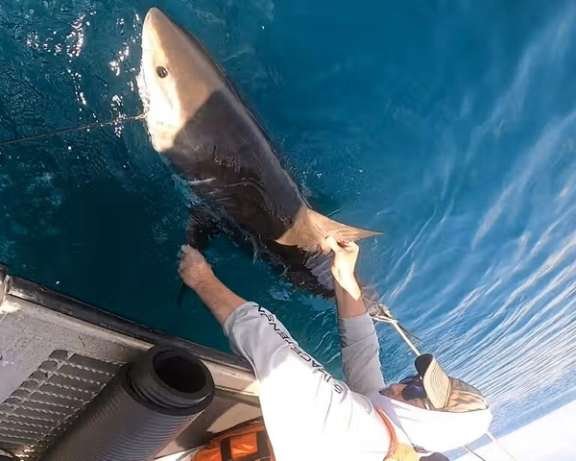
The sharks are temporarily caught using baited hooks, and a sensor is attached to the dorsal fin in less than five minutes. As the shark approaches the surface, the device transmits the collected data through a satellite network. The attachment material eventually degrades, allowing the sensor to detach from the animal.
Researchers assess each shark before releasing it to ensure that it has not been seriously harmed.
Scientists hope the data will provide a clearer picture of ocean temperatures and conditions and eventually help improve forecasts of storm intensity, giving coastal communities along the eastern United States more time to prepare.
Researchers have previously used marine animals, including elephant seals, to collect ocean data. They say sharks could offer a particularly useful source of information because of their wide distribution across the ocean.
The project remains an experimental approach, but researchers say data collected by mobile animals could complement conventional ocean-monitoring systems and fill gaps in areas that are difficult for fixed instruments to reach.