

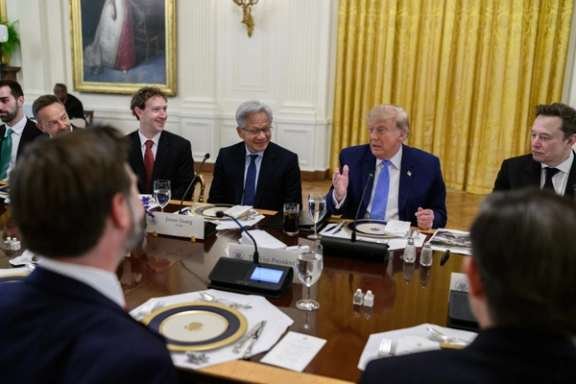
U.S. President Donald Trump brought together senior technology and artificial intelligence executives at the White House on September 29 for a meeting focused on AI safety, computing infrastructure and the direction of U.S. policy toward one of the world’s fastest-growing technologies.
Executives from companies including Google, Meta, Nvidia, Anthropic and OpenAI attended the meeting, which Trump described as a sign of cooperation between his administration and the technology industry.
The most significant outcome was a voluntary agreement on AI safety. Trump described the document as “almost like a constitution,” saying that some of the world’s leading technology figures had signed it alongside him.
Despite the president’s characterization, the agreement does not carry the same legal force as a federal law. Its provisions instead rely on voluntary commitments by participating companies.
Under the agreement, technology companies are expected to strengthen safety mechanisms within their AI systems. The measures include controls designed to prevent unintended behavior, mechanisms for identifying problems quickly and cooperation with independent auditors examining the performance and safety of advanced systems.
The agreement comes amid growing concerns about increasingly capable AI models and autonomous AI agents. Researchers and technology leaders have been debating how to manage systems that can perform increasingly complex tasks with limited human intervention.
The reliance on voluntary commitments has also raised questions about the limits of industry self-regulation. Critics argue that without legally enforceable requirements and independent regulatory mechanisms, companies may retain significant control over how safety standards are defined and implemented.
A second major issue at the White House meeting was the expansion of data centers. Advanced AI models require enormous computing capacity and large amounts of electricity, making data centers a critical part of the technology industry’s infrastructure.
Trump has supported rapid expansion of data center capacity in the United States, linking the construction of these facilities to technological leadership, economic activity and industrial development.
At the same time, data center projects have generated concerns in some communities over electricity demand, pressure on power grids, water consumption and other local environmental and infrastructure impacts.
Nvidia CEO Jensen Huang has argued that advanced data centers should be viewed as a new form of industrial infrastructure. He has suggested describing them as “superintelligence factories,” emphasizing their role in producing and operating increasingly capable AI systems.
The meeting also coincided with a significant change in the terminology used by the U.S. government.
Trump signed an executive order directing federal agencies to use the term “superintelligence” in place of “artificial intelligence” in certain official communications, including specified correspondence, reports and government websites.
The terminology change has technical implications. Artificial intelligence is a broad term covering a wide range of systems and capabilities, while superintelligence generally refers to hypothetical or advanced systems whose capabilities would substantially exceed those of humans across many areas.
As a result, treating the two terms as interchangeable has prompted discussion among technology specialists about whether a distinction between existing AI systems and hypothetical superintelligent systems should be maintained.
Taken together, the White House meeting illustrates three major challenges confronting U.S. AI policy: how to improve the safety of increasingly capable systems, how to build the enormous computing infrastructure required to develop them, and how to divide responsibility between technology companies and government regulators.
The Trump administration is emphasizing rapid technological development, expanded computing infrastructure and cooperation with major technology companies, while relying substantially on voluntary industry commitments rather than making stricter government regulation the central mechanism of AI oversight.
Supporters of industry-led safeguards see voluntary agreements as a way to respond quickly to a rapidly changing technology. Critics, however, argue that the most consequential AI risks may require enforceable standards and independent oversight rather than commitments that companies can voluntarily adopt.
For Nimruz, the significance of the White House meeting therefore extends beyond the decision to change official terminology. It reflects a broader policy debate over who should be responsible for AI safety, how quickly the infrastructure behind the technology should expand and how the United States can pursue technological leadership while addressing the risks created by increasingly powerful systems.
The outcome of that debate could shape not only the future of the U.S. technology industry, but also the standards that influence how advanced AI is developed, deployed and regulated internationally.