

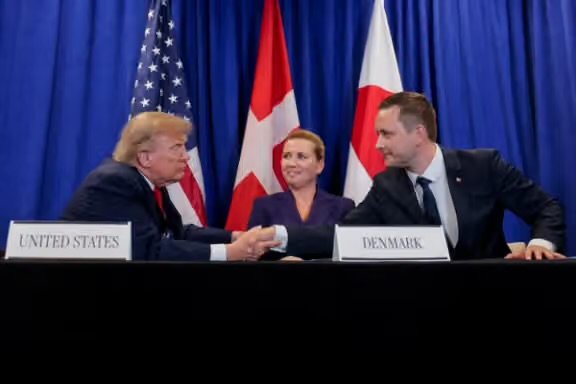
US President Donald Trump, Danish Prime Minister Mette Frederiksen and Greenland Prime Minister Jens-Frederik Nielsen have signed a trilateral security agreement that significantly expands the United States’ military role in Greenland, marking a shift from months of confrontation over Trump’s territorial ambitions toward a long-term Arctic security arrangement.
The agreement was signed Tuesday, September 22, on the sidelines of the 81st session of the United Nations General Assembly in New York.
Unlike Trump’s previous demand for US control or acquisition of Greenland, the new agreement does not transfer sovereignty over the territory. Greenland remains a self-governing part of the Kingdom of Denmark, while the agreement places its expanded security cooperation within the broader NATO framework.
Under the accord, the United States can establish a “Golden Dome” missile-defense system in Greenland to address ballistic missile threats. The agreement also creates the possibility of new US defense areas at Narsarsuaq in southern Greenland and Mestersvig in the east.
Narsarsuaq was previously home to a US base during the Cold War, while Mestersvig is currently used by Denmark’s Sirius Dog Sled Patrol.
The United States already operates Pituffik Space Base in northwestern Greenland, a facility important for missile warning, missile defense and space surveillance. The new agreement allows Washington to modernize and expand its activities there and to establish additional defense areas in Greenland.
Trump said before the signing that the agreement gives the United States “permanent control over security” and other security-related needs in Greenland. He also said the United States would begin developing a larger military presence and two major military bases.
The agreement does not have a fixed end date and provides broad US military mobility across Greenland, including access involving aircraft, ships and undersea operations.
It also restricts the ability of non-NATO countries to establish military installations or maintain a persistent military presence in Greenland. The agreement further places restrictions on certain sensitive foreign investments, particularly in areas linked to critical infrastructure and resource extraction.
The new arrangement modifies the 1951 US-Danish defense framework that has provided the legal basis for the American military presence in Greenland.
Frederiksen described the agreement as one that could “last forever” while emphasizing the importance of NATO and Greenland’s right to self-determination.
Nielsen likewise stressed the importance of maintaining a strong NATO presence in the Arctic. He said Greenland and the United States would need to work to rebuild trust after months of tension caused by Trump’s previous statements about acquiring the territory.
The agreement is the result of months of negotiations between Washington, Copenhagen and Nuuk following Trump’s repeated statements that the United States needed control of Greenland for national security reasons.
Trump’s earlier refusal to rule out economic or military pressure to acquire the territory created a serious dispute with Denmark, a NATO ally, and generated concern across Europe.
The new agreement represents a significant change in the nature of that dispute. Washington has not obtained ownership or sovereignty over Greenland, but it has secured a framework for a substantial expansion of its military and security presence.
For Denmark and Greenland, the agreement maintains the existing constitutional status of the territory while placing Arctic security within the NATO alliance and explicitly recognizing Greenland’s right to self-determination.
Greenland’s strategic importance is central to the agreement. The island sits between North America and Europe along routes of growing military and commercial significance. Melting sea ice is also opening new maritime possibilities, while competition over Arctic resources and access is increasing.
The agreement therefore extends beyond the personal dispute between Trump and Danish leaders. It reflects a broader shift in Arctic security, where the United States and its allies are seeking stronger military infrastructure as competition with Russia and China intensifies.
Russia has said the agreement is a matter for the parties involved, while noting that Arctic cooperation between Moscow and Washington is not currently on the agenda.
The agreement still requires parliamentary approval in Denmark and Greenland, meaning the signing is not the final step in the legal process.
Its long-term significance will depend on how quickly the planned defense areas and military infrastructure are developed, how the agreement is implemented within NATO and how Greenland’s political institutions and population respond to the expanded US presence.
The immediate result, however, is clear: the months-long dispute over possible US acquisition of Greenland has shifted toward a security arrangement that preserves Danish sovereignty while giving Washington substantially greater military access and a more permanent role in the defense of the strategically important Arctic territory.