

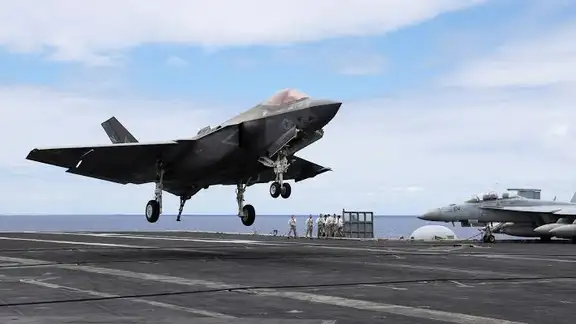
A proposed $24 billion sale of advanced F-35 fighter jets to Saudi Arabia is facing a new security concern in Washington: U.S. intelligence officials fear China could gain access to sensitive American military technology through its expanding defense and security relationship with Riyadh.
According to The New York Times, citing U.S. officials, intelligence officers have raised concerns in internal reports that China could acquire F-35 technology either through espionage in Saudi Arabia or through its military and security cooperation with the kingdom. The reports include a recent assessment by the Pentagon’s Defense Intelligence Agency. oai_citation:0‡New York Times
The concern centers on the highly sensitive technology incorporated into the F-35, particularly its advanced radar, surveillance and other systems designed to provide the aircraft with sophisticated capabilities while limiting its detectability.
One U.S. official said the latest intelligence assessment emphasizes that access to facilities where F-35 technology is stored should be restricted to Saudi and American personnel. The purpose of such controls would be to reduce the possibility of sensitive information reaching Chinese military or intelligence organizations.
The issue is particularly significant because Saudi Arabia has maintained a decades-long military relationship with the United States while simultaneously developing important defense ties with China. Riyadh has purchased ballistic missiles from Beijing, and Chinese military cooperation with Saudi Arabia has included assistance related to ballistic-missile capabilities and infrastructure.
That combination creates a difficult security equation for Washington. Saudi Arabia is a major American defense customer, but its military relationship with China means U.S. officials are assessing whether highly sensitive American technology could be exposed after being deployed on Saudi territory.
The reported intelligence concerns do not establish that China has obtained F-35 technology, nor do they show that Saudi Arabia intends to transfer American technology to Beijing. Rather, they reflect an assessment of the potential risks associated with the proposed sale. The officials cited in the report spoke on condition of anonymity.
The proposed deal has reportedly advanced through the U.S. approval process. The State Department sent Congress a package covering 48 aircraft and a spare engine in June, according to reporting based on the intelligence assessments. Lawmakers and congressional aides have subsequently questioned administration officials about the security risks identified by the intelligence community. oai_citation:1‡Hindustan Times
The concerns also have implications for Israel. Israeli officials and security circles have historically focused on maintaining Israel’s qualitative military edge in the region, and the potential transfer of advanced F-35 capabilities to Saudi Arabia has therefore attracted attention in Israel.
For Washington, the issue is ultimately larger than a single arms sale. The F-35 is among the United States’ most advanced military aircraft, and protecting its technology is a central consideration whenever the aircraft is exported to another country.
The Saudi case is especially sensitive because Riyadh maintains defense relationships with both Washington and Beijing. The proposed sale therefore places the United States between two objectives: strengthening its security partnership with Saudi Arabia while limiting the possibility that a major strategic competitor could gain access to sensitive American military capabilities.
At this stage, the reported intelligence warnings represent concerns and risk assessments rather than evidence that Chinese espionage has occurred. The key question is whether Washington can establish sufficient safeguards around the F-35 before approving the transfer of the aircraft — and whether those safeguards would be considered adequate by U.S. intelligence and defense officials.