
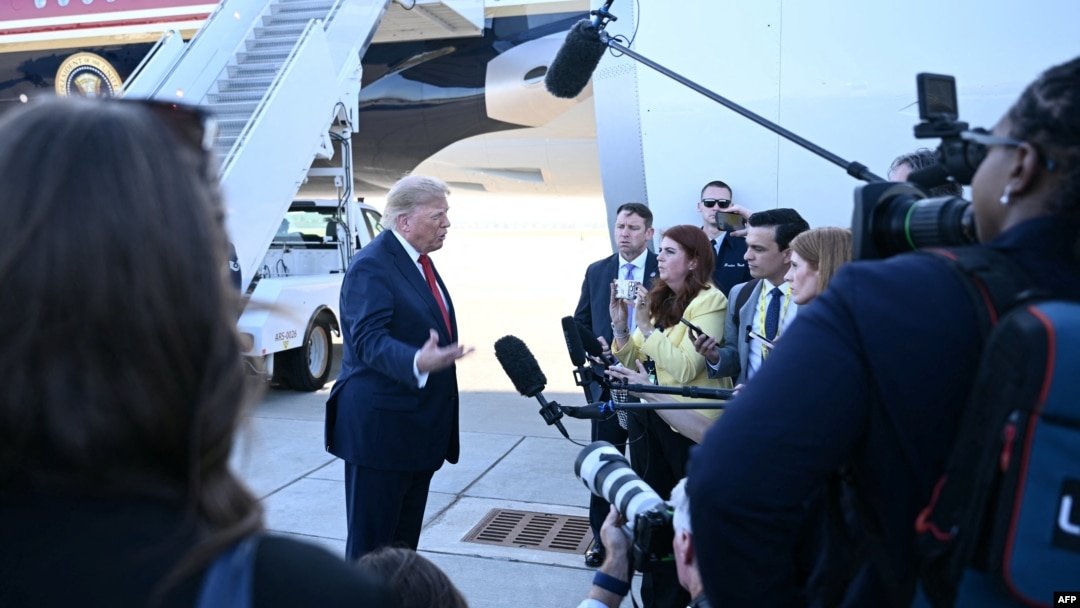
U.S. President Donald Trump says Iran has directly contacted his administration seeking a deal with Washington, while Tehran has not publicly confirmed the claim. The statement comes as Trump says he hopes the seven-month war is nearing an end and as Washington prepares to discuss the conflict’s next phase with Gulf states.
Speaking to reporters after arriving in North Carolina on Wednesday, Trump said he hoped the war was approaching its conclusion and claimed that Iran “wants to make a deal.” Asked whether the contact from Tehran had been direct or through intermediaries, Trump said it was direct but did not provide details. Reuters separately reported that Trump said he hoped the conflict was nearing an end. oai_citation:0‡Reuters
The claim remains unconfirmed by Iranian authorities. Just days earlier, Mohsen Rezaei, secretary of Iran’s Supreme National Security Council, said Tehran would not negotiate with Washington until its conditions were met. Rezaei warned against what he described as changing signals from the U.S. president and said there would be no talks until Iran’s conditions were satisfied. oai_citation:1‡Times of Israel
Trump later repeated his expectation that the war could end soon, saying it could lead to what he described as a “really good ending.” He has also continued to emphasize that preventing Iran from obtaining a nuclear weapon remains a central U.S. objective.
The conflicting public messages highlight the uncertainty surrounding the current diplomatic picture. Trump’s claim of direct contact, by itself, does not establish that formal negotiations have begun, nor does it demonstrate that Tehran and Washington have agreed on the terms of a settlement.
Another significant diplomatic development is expected next week. According to reports citing Axios, Trump is expected to meet leaders or foreign ministers from the six Gulf Cooperation Council states — Saudi Arabia, the United Arab Emirates, Qatar, Bahrain, Kuwait and Oman — on the sidelines of the United Nations General Assembly in New York on September 22. The discussions are expected to address the next phase of the conflict and U.S. planning for the period after the war. oai_citation:2‡Reuters
The timing is significant for the Gulf states, which have faced the regional consequences of the conflict, including attacks and disruption to energy infrastructure and shipping. Reuters reported that the wider escalation involving Iran and Iran-aligned forces has heightened risks to oil supplies and pushed energy prices higher. oai_citation:3‡Reuters
The economic dimension is also becoming increasingly important for Washington. Higher energy prices and disruptions to global oil supplies have created additional pressure as the U.S. administration approaches the November midterm elections. Reuters has reported that the conflict’s impact on energy markets has become a growing domestic concern. oai_citation:4‡Reuters
Vice President J.D. Vance has previously suggested that the conflict could enter a “very different” phase within one or two months, although he did not specify whether that would mean de-escalation, intensified military action or a diplomatic settlement.
For now, the central question is whether the contact claimed by Trump develops into an identifiable negotiating channel. Iran’s publicly stated position has recently emphasized that talks depend on Tehran’s conditions being met, while Washington is signaling that it sees a possible path toward an agreement.
If negotiations do emerge, several major issues are likely to shape them: Iran’s nuclear program, sanctions, the security of the Strait of Hormuz, regional security arrangements and the terms for ending the conflict.
The latest developments therefore point to a possible diplomatic opening, but not yet to a confirmed negotiation or agreement. The gap between Trump’s statements and Iran’s publicly stated position remains the key uncertainty — and whether that gap can be narrowed will determine whether the reported contact becomes a genuine route toward ending the war.