
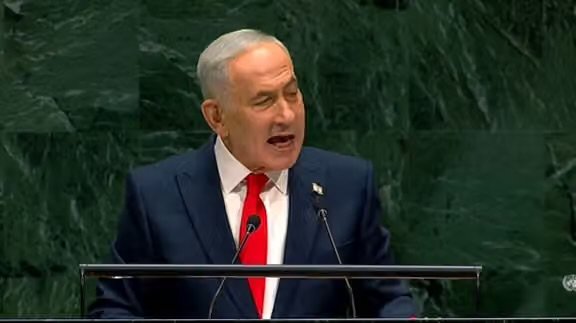
Israeli Prime Minister Benjamin Netanyahu launched a sharp verbal attack on Turkish President Recep Tayyip Erdogan during his address to the 81st United Nations General Assembly, describing him as a “tyrant” and accusing Türkiye of supporting Hamas and pursuing destabilizing regional policies.
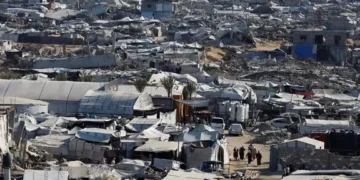
Netanyahu’s remarks came after Erdogan used his own UN address earlier this week to strongly condemn Israel’s military conduct in Gaza, call for greater international pressure on Israel and support wider recognition of a Palestinian state.
In his speech, Netanyahu accused Erdogan of hosting senior Hamas figures in Türkiye and alleged that the Turkish president had overseen the killing of thousands of Kurdish civilians and the imprisonment of journalists and political opponents. Netanyahu also claimed that Erdogan had effectively set a global record for imprisoning journalists and opposition leaders.
Those statements were presented by Netanyahu as part of a broader indictment of Türkiye’s domestic and foreign policies. Several of the accusations reflect long-standing political disputes and competing narratives between the Israeli and Turkish governments.
Netanyahu also accused Türkiye of contributing to what he described as the spread of antisemitic claims. He further criticized Erdogan over the Armenian genocide, saying the Turkish president denies the genocide, a highly sensitive historical and political issue between Türkiye and Armenia.
The Israeli prime minister also turned to Cyprus, Greece and Syria. He accused Ankara of illegally occupying northern Cyprus, criticized Turkish policy toward Greece and claimed that Erdogan is seeking to expand Türkiye’s influence in Syria.
Netanyahu then directly addressed Erdogan’s position on Jerusalem, declaring that the city is Israel’s capital and saying: “This is our country, our city and our eternal capital.”
The exchange reflects the depth of the political and diplomatic deterioration between Israel and Türkiye. Once important security partners, the two countries have become increasingly divided over the Palestinian issue, Hamas and Israel’s military campaign in Gaza.
Erdogan has repeatedly condemned Israel’s actions in Gaza and has described them in terms of genocide. Israel rejects that characterization and says its military campaign is directed against Hamas.
In his UN address, Erdogan called for international pressure to end the war and for Gaza’s reconstruction, while also supporting the establishment and wider international recognition of a Palestinian state.
The confrontation between the two leaders therefore goes beyond a personal exchange. It reflects a wider regional struggle over Gaza, the Palestinian question, Hamas, Syria, Jerusalem and Türkiye’s role in the Middle East.
For the United Nations General Assembly, the exchange once again demonstrated how the Gaza war has turned the international forum into a stage for competing political narratives. Netanyahu used the platform to challenge Türkiye and Erdogan directly, while Erdogan used his address to place Israel’s conduct in Gaza at the center of his criticism.
The significance of the confrontation lies not only in the language used by the two leaders, but in what it reveals about the broader Israel–Türkiye relationship: political disagreements over Gaza have increasingly spilled into disputes over regional security, historical questions, domestic governance and the future balance of power in the Middle East.