

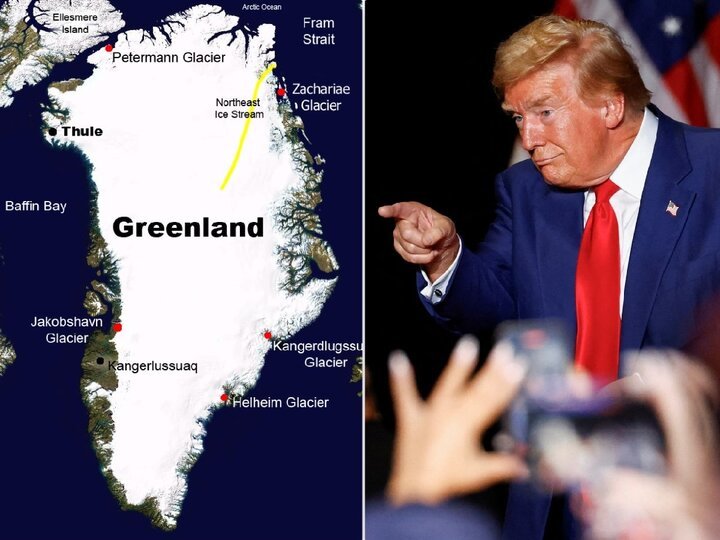
The United States, Denmark and Greenland have reached an agreement that significantly expands Washington’s long-term security role on the strategically important Arctic island, marking a shift away from months of confrontation over Donald Trump’s earlier push for greater US control of Greenland.
Trump said on September 18 that the agreement gives the United States “permanent control” over Greenland’s security and related needs, and guarantees Washington the ability to take what he considers necessary measures to defend Greenland and the United States.
Details released so far indicate that the agreement gives the United States permanent access, basing and overflight rights in Greenland. It also seeks to prevent countries regarded as US adversaries from establishing military bases or maintaining a military presence on the island.
The agreement reportedly places restrictions on sensitive investments by countries outside NATO, with US approval required for certain such investments. However, important details remain unclear, including the precise scope of Washington’s authority and whether the agreement will directly result in the construction of additional US military bases.
The deal does not amount to a transfer of Greenland’s sovereignty to the United States. Greenland remains a self-governing territory within the Kingdom of Denmark, and Danish officials have said that the agreement preserves Denmark’s sovereignty and Greenland’s right to self-determination.
Danish Prime Minister Mette Frederiksen has described the agreement as a potential step toward strengthening security in the Arctic and North Atlantic. Greenland’s Prime Minister Jens-Frederik Nielsen has also said the agreement strengthens the territory’s security.
The arrangement comes after months of diplomatic tension triggered by Trump’s repeated statements that Greenland was important to US national security and that Washington needed greater control over the island.
At the height of the dispute, Trump did not rule out economic or military pressure to secure US control of Greenland, prompting strong reactions in Denmark and concern among European allies.
The new agreement changes the nature of that dispute. Rather than transferring ownership or sovereignty, the arrangement focuses on expanding the American military and security presence while restricting the ability of US strategic competitors to establish their own foothold on the island.
Greenland’s geographic position helps explain its importance. Located between North America and Europe and close to key Arctic and North Atlantic routes, the island has significance for military surveillance, missile warning, air operations and maritime security.
The United States already has military infrastructure in Greenland under a 1951 defense agreement with Denmark, which was later updated. The new arrangement is intended to provide Washington with broader and more permanent access and security rights.
The agreement also carries implications for the wider Arctic balance of power. As competition among the United States, Russia, China and other states increases in the region, military access, infrastructure, shipping routes and investment in strategic resources have become increasingly important.
At the same time, Greenland’s political future remains a separate issue. The territory has its own government and parliament, while pro-independence political forces have continued to argue that Greenlanders should have greater control over their future.
The reported agreement is therefore not a settlement of Greenland’s sovereignty question. Instead, it represents a new framework for security cooperation in which Washington is set to have a more permanent military role while Denmark and Greenland retain their existing constitutional status.
The most important unanswered question is how the new powers will work in practice. The political announcement has outlined broad strategic commitments, but the full text and detailed implementation mechanisms will determine the actual limits of US authority.
What is already clear is that Greenland has moved from being the subject of a US territorial acquisition debate to becoming a central pillar of Washington’s long-term Arctic security strategy. The agreement places the island even more firmly at the intersection of US national security, Danish sovereignty, Greenlandic self-determination and the broader competition for influence in the Arctic.