
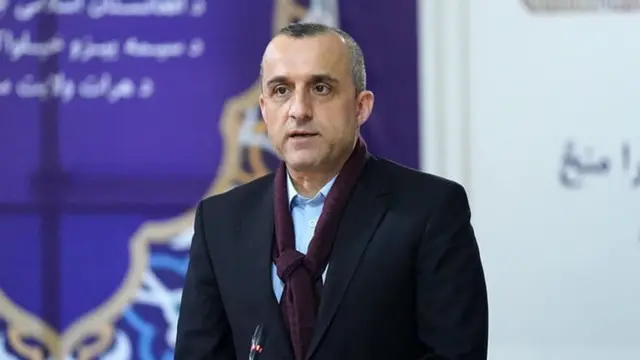
Former Afghan Vice President Amrullah Saleh has sharply criticized recent debate over the use of the word “national,” arguing that under Taliban rule the term has become associated more with crisis and disaster than with unity or a shared national identity.
In a statement, Saleh wrote: “In the Taliban’s territory, apart from national disaster and national crisis, nothing else has ‘national’ as a prefix or suffix.”
Saleh also criticized the focus on political labels, saying attention should instead be directed toward what he described as the struggle to free Afghanistan from its current situation.
His latest remarks are part of his continuing political criticism of the Taliban, which has largely focused on Afghanistan’s political system and the need for fundamental change.
The comments come as the use of the word “national” in the names of institutions, political movements and other initiatives remains contested in Afghanistan’s political environment.
Saleh’s statement therefore goes beyond a debate over terminology. It represents a broader political challenge to the Taliban’s portrayal of the country’s current condition and seeks to frame the political discussion around what he considers the need for change.
From Nimruz’s perspective, the significance of the statement lies in the competing narratives over Afghanistan’s political reality. Taliban officials emphasize stability and governance, while their political opponents continue to describe the current system as a crisis and call for change.
This makes seemingly simple terminology part of a much larger political contest over who has the authority to define Afghanistan’s present condition and its political future.
Ultimately, Saleh’s remarks show how even a word such as “national” can become politically charged in Afghanistan. His central message is that the debate should move beyond titles and focus instead on the country’s political future and possible paths out of the current situation.