
A joint investigation involving Pakistan, Sri Lanka and the United States has uncovered 671 kilograms of methamphetamine, according to Pakistan’s Anti-Narcotics Force, exposing the increasingly cross-border nature of drug trafficking routes linked by Pakistani authorities to Afghanistan.
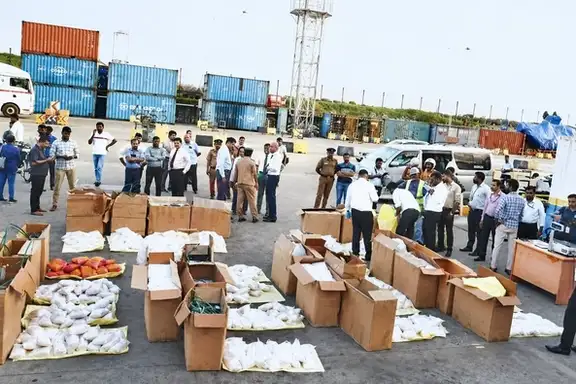
Pakistan’s Anti-Narcotics Force said on Friday, September 4, that 200 kilograms of methamphetamine were seized from a container at Karachi port. A man identified as Ehsanullah, described by Pakistani authorities as an Afghan national and an alleged leader of the network, was arrested along with several local associates.
According to Pakistani authorities, information obtained during Ehsanullah’s interrogation was shared with Sri Lankan authorities and the US Drug Enforcement Administration.
The intelligence subsequently contributed to a joint operation at Colombo port, where Sri Lankan authorities and the US Drug Enforcement Administration seized another 471 kilograms of methamphetamine hidden inside cargo, Pakistan’s Anti-Narcotics Force said.
The total value of the seized drugs was estimated at about $21 million.
Pakistani authorities said the network intended to use Pakistan as a transit route for moving drugs to other countries. The agency described Pakistan as both a transit corridor and a victim of drugs originating in Afghanistan.
However, the case contains an important discrepancy in the accounts provided by the countries involved. Two days earlier, Sri Lankan police and the US Embassy in Colombo had reported the seizure of nearly half a tonne of methamphetamine in a joint operation. The initial Sri Lankan account identified the network as Pakistani and said two Pakistani nationals had been arrested.
The differing descriptions do not, by themselves, establish where the drugs originated or which individuals controlled the wider network. A trafficking route can involve production, storage, financing and transportation across several countries, making nationality and transit location insufficient to establish the full structure of a criminal network.
The reported cooperation between Pakistan, Sri Lanka and the United States also highlights the growing importance of intelligence sharing in disrupting international drug trafficking. Information obtained in one country can lead to seizures thousands of kilometres away, particularly when traffickers use maritime cargo routes to move narcotics between markets.
From the perspective of Nimruz, the significance of the case lies in the regional trafficking network rather than simply the quantity of drugs seized. Pakistan’s claim of an Afghan connection, alongside Sri Lanka’s initial reference to Pakistani suspects, points to a trafficking environment in which multiple countries can serve different functions within the same supply chain.
If further investigations independently establish that the seized methamphetamine originated in Afghanistan, the case could increase pressure on the Taliban and regional governments to strengthen controls over drug production, financing and cross-border trafficking. But the seizure itself does not prove that any particular government organized or supported the network.
The immediate test will therefore be whether investigators can establish the drugs’ origin, identify the network’s financial and logistical structure, and determine the roles of those arrested. Until those findings are supported by independent evidence or judicial proceedings, claims about the network’s Afghan links should remain allegations rather than established facts.