
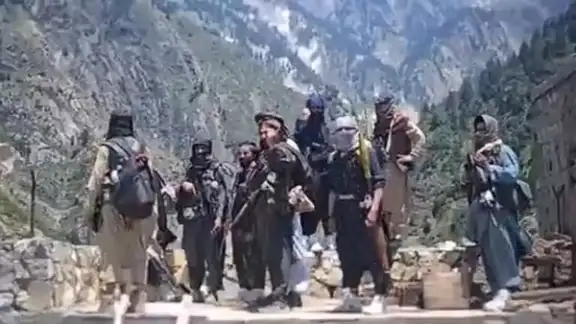
The Taliban have intensified pressure on Tehrik-e-Taliban Pakistan, or TTP, across several Afghan provinces over the past three weeks, with six sources in Afghanistan and Pakistan telling Nimruz that around 20 commanders and Afghan associates of the group have been detained.
According to information obtained by Nimruz, TTP members and people linked to the group have been detained in Kabul, Khost, Paktika, Kunar, Ghazni, Maidan Wardak, Kandahar and Uruzgan.
A source in South Waziristan who has been closely following the reported arrests said those detained include Sher Zaman Aka, described as a senior TTP commander; Maulvi Badri, a former head of the group’s economic commission; Pir Zaman, a member of its Balochistan leadership; Haji Hussain, the group’s commander in Paktika, also known as Haji Kalan; as well as Ikhlas Yar and Mukhlis Mehsud.
The source said Ikhlas Yar had been living in Kabul and was detained from his residence.
However, a local TTP official told Nimruz that Ikhlas Yar is currently in South Waziristan and has not been detained. The conflicting accounts could not be independently resolved.
Sources also reported the detention of several local commanders linked to Hafiz Gul Bahadur’s group, including Darwish Dawar, Nasir Fateh and Ghazi Wazir. They said most of these individuals are not considered senior figures within the group.
Fighters reportedly ordered to leave Afghanistan
A TTP official in Peshawar confirmed that arrests had taken place and said “a large number of fighters” had been detained in recent weeks.
The official told Nimruz that some TTP commanders were detained after being instructed to leave Afghanistan but remaining in the country.
According to the source, houses linked to TTP members were searched in Argun in Paktika; Nawah Deh, Laman, Gomal, Bori Khel and Camp Gulan in Khost’s Gurbuz district; Salarai in Maidan Wardak; as well as locations in Ghazni, Kunar, Helmand and other areas.
Sources also said the Taliban detained several Afghan citizens on suspicion of having links to or cooperating with TTP fighters.
Two sources in Kandahar and Uruzgan told Nimruz that searches were conducted at some homes in Aino Mina, Maywand and Panjwayi districts, as well as in Kandahar city.
Sources further said that houses belonging to some Afghan Taliban members who travelled to different parts of Khyber Pakhtunkhwa to fight alongside TTP were searched and that several people were detained.
Along the Kandahar-Uruzgan road, some roadside shops and locations collecting financial assistance for families displaced from Pakistan’s tribal areas were also reportedly closed.
Sources said homes linked to TTP in Kaisi, Albek, Shah Wali, Sozniyan, Chenar, Karizgi and Chenartu were not searched.
Why are the Taliban increasing pressure?
The reported crackdown comes after years of pressure from Pakistan on the Taliban to take concrete action against TTP.
Pakistan has repeatedly accused the Taliban of allowing TTP to operate from Afghan territory. The Taliban have rejected the accusation, saying TTP is an internal Pakistani issue and that no individual or group is allowed to use Afghan territory against another country.
The Taliban have also accused Pakistan of supporting groups opposed to them inside Afghanistan.
A senior Pakistani government source who spoke to Nimruz on condition of anonymity said the Taliban had provided Pakistan with reports of the recent operations.
“But we have to see whether this is really a serious action or not,” the official said.
The official added that previous measures presented as similar crackdowns had produced only “superficial and short-term” results.
The statement reflects Islamabad’s current concern: Pakistan is not only watching whether arrests are made, but whether they produce a sustained reduction in TTP’s operational capacity.
A TTP media official, discussing the arrests, argued that the group’s position toward the Afghan Taliban was rooted in a different political and demographic reality. He said the Taliban’s emir represents roughly 40 million Afghans, while TTP claims a circle of influence and support in a country of around 270 million people.
Where is Mufti Noor Wali?
The reported pressure on TTP in Afghanistan coincides with the release of new videos purportedly showing Mufti Noor Wali, the group’s leader.
In one recent video reportedly filmed in Kurram, Noor Wali is seen speaking with workers at a stone-mining company. In another video, sources claim he directs an attack operation using a drone.
Pakistani officials have repeatedly alleged that Noor Wali lives in a safe location in Afghanistan under Taliban protection.
However, following an alleged attack on Noor Wali’s vehicle in Kabul in October 2025, this is the second reported appearance of the TTP leader in Pakistan’s tribal areas.
Noor Wali previously appeared in an eight-minute video on October 16, 2025, rejecting reports of an attack against him and saying he was living in Khyber district.
The new videos have emerged as the Taliban reportedly increase pressure on TTP-linked individuals and facilities inside Afghanistan.
Sources also told Nimruz that contact with Hafiz Gul Bahadur, the leader of another Pakistani Taliban faction, has been unavailable for several days. No further details about his condition were available.
The Taliban have not officially commented on the reported arrests of TTP commanders and fighters. Pakistani security officials have also not formally confirmed the reports.
Nimruz Exclusive Angle
If the reported arrests are confirmed, they could indicate a significant shift in the Taliban’s practical approach toward TTP.
The Taliban have politically distanced themselves from TTP while maintaining that the group’s activities are Pakistan’s internal problem. Sustained action against TTP would therefore represent a potentially important change in how Kabul manages one of the most sensitive sources of tension with Islamabad.
But the number of arrests alone is not enough to establish such a shift.
The critical question is whether the Taliban impose lasting restrictions on TTP’s commanders, fighters, financing and logistical networks, or whether the current pressure is a temporary response to Pakistan’s demands.
Final Analysis
The significance of these developments extends beyond the reported detention of around 20 people.
If the Taliban sustain restrictions on TTP’s operations inside Afghanistan, one of the central security disputes between Kabul and Islamabad could enter a new phase. It could also create space for greater security dialogue between the two sides.
If the measures prove temporary and TTP activity resumes, Pakistan is likely to continue accusing the Taliban of providing the group with sanctuary.
The real test, therefore, will not be the announcement or number of arrests, but whether the Taliban can prevent the organized use of Afghan territory for operations against Pakistan. That outcome could become a decisive factor in the future of Kabul-Islamabad security relations.