

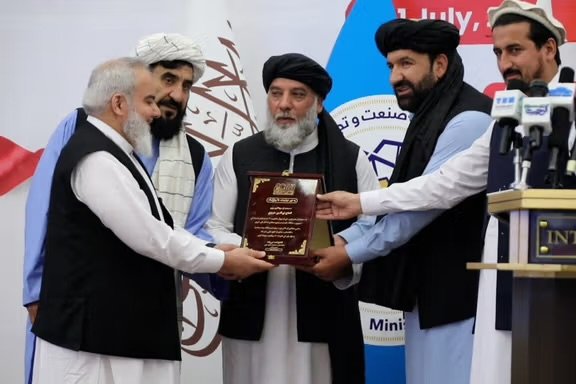
The Taliban’s Ministry of Industry and Commerce says Afghan private-sector companies have signed 50 cooperation agreements worth a combined $1 billion with foreign firms, including companies from Iran, during the Fifth International Industry and Mining Exhibition.
Speaking at the closing ceremony on Tuesday, Taliban Industry and Commerce Minister Nooruddin Azizi said the administration had reduced customs tariffs on industrial machinery and was planning to cut corporate income tax from 20 percent to 10 percent. He also announced that newly established industries would receive a five-year tax exemption.
Azizi urged manufacturers to establish factories in designated industrial zones, avoid what he described as unfair competition and set product prices in line with market conditions.
Despite announcing agreements valued at $1 billion, the ministry has not disclosed the names of the foreign companies involved, the specific projects covered, implementation timelines or the value of individual agreements. The lack of publicly available details makes it difficult to independently assess the scope or feasibility of the announced deals.
The announcement coincides with a new report by the United Nations Development Programme (UNDP), which says the Taliban have struggled to attract both domestic and foreign investment. According to the report, political restrictions imposed by the Taliban, together with financial instability, continue to discourage investors and weaken the role of the private sector in Afghanistan’s economy.
Taken together, the two accounts present sharply different assessments of Afghanistan’s economic outlook. While the Taliban highlight major investment agreements and new tax incentives, the UN maintains that political, legal and economic constraints remain significant obstacles to sustainable investment and long-term economic recovery.