
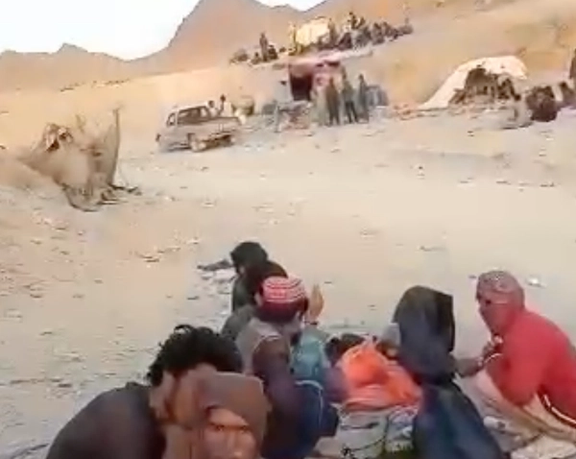
At least 17 Afghan migrants, including women and children, have reportedly died from severe dehydration in a remote border area near Saravan in Iran, according to the human rights organization HalVash.
HalVash said the incident occurred on Thursday, September 10, in the Mak-Sukhteh area near the Rutak border region of Saravan. The bodies were later transferred to a morgue in Khash, reportedly because the morgue in Saravan lacked sufficient capacity.
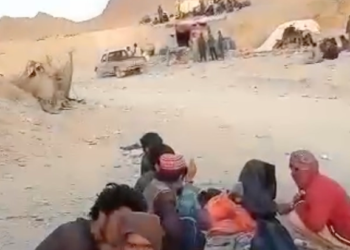
Videos released by HalVash show people digging several graves at an unidentified location. The organization said it has not been able to independently verify the exact number of deaths or all details of the incident, while investigations into the identities of other victims and the circumstances surrounding the deaths continue.
According to HalVash, five of the reported victims were members of a family from Afghanistan’s Baghlan province: a 45-year-old mother and her four daughters, aged 22, 18, 16 and 14. Relatives of the family live in Saravan, and their funeral prayer was reportedly scheduled for Sunday.
HalVash also reported that at least six children under the age of 14 were among the other victims. Witnesses and relatives said the migrant group faced an extreme shortage of water during the journey and that several people died close to one another along the route.
One relative told HalVash that the men traveling with the group separated from the women and children partway through the journey. The women and children then continued without adequate access to water, according to the relative.
Four days after the reported incident, families were still dealing with the difficult process of recovering, identifying and burying their relatives. The transfer of the bodies to Khash also highlights the practical challenges families can face even after a fatal migration journey, including access to morgue facilities, identification and transportation.
If the death toll reported by HalVash is confirmed, the incident would rank among the deadliest reported cases involving Afghan migrants traveling through remote desert routes along the Iranian border. However, the final number of victims and the precise circumstances of their deaths cannot yet be established independently.
From the perspective of Nimruz, the reported deaths highlight a danger that can receive less attention than detention, deportation and border security: the absence of basic survival resources along informal migration routes. In remote desert areas, a lack of water can become fatal within a short period, particularly for children, women and other vulnerable travelers.
The case also illustrates how the risks of irregular migration do not necessarily end when people cross a border. Families may then face another ordeal — locating their relatives, identifying bodies, arranging transportation and completing burial procedures, often without clear information about what happened.
The reported deaths therefore represent more than a migration statistic. They point to the human cost of increasingly dangerous and informal routes used by Afghans seeking to cross borders, while the lack of independent verification means the precise scale of the tragedy still requires further investigation.