
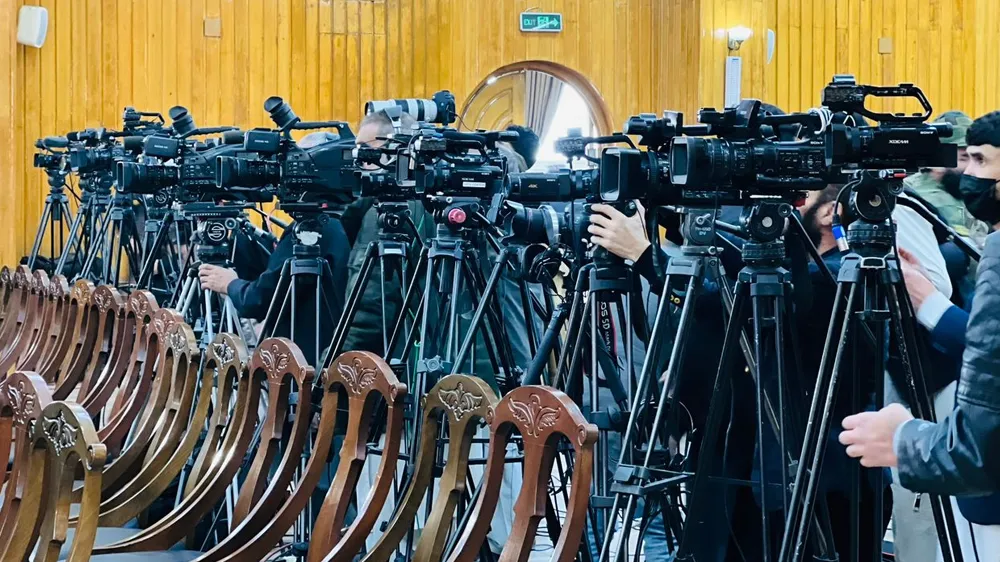
Twelve journalists were briefly detained by Taliban morality officials in Khost while covering a book exhibition, with their cameras confiscated and not immediately returned, according to the Afghanistan Journalists Center.
The journalists were detained on Tuesday while covering the exhibition in the second district of Khost city. The Afghanistan Journalists Center, citing a local source, said the journalists were released after their cameras were seized, but the equipment had not been returned at the time of its report.
A local journalist told the center that the journalists had attended the exhibition at the invitation of the Taliban Information and Culture Department in Khost. The Taliban morality officials nevertheless detained them and, according to the journalist, treated them in a humiliating manner.
The local journalist said the Taliban governor’s office and other local officials were informed of the incident, but the journalists’ equipment had still not been returned about four hours after their detention.
The Afghanistan Journalists Center said the action was linked to restrictions on broadcasting images of living beings under the Taliban’s morality law. According to the center, the restriction has so far been enforced in 25 Afghan provinces.
The center said, however, that the restriction has not been formally announced in Khost, although local journalists and media outlets have repeatedly faced unofficial pressure to comply with it.
The organization described the treatment of the journalists as humiliating and contrary to human and professional dignity. It called on the Taliban to end such conduct, immediately return the journalists’ cameras and allow journalists to carry out their professional duties without fear of detention or threats.
The Khost incident goes beyond a dispute over camera equipment. The journalists were reportedly covering an event after being invited by the Taliban’s own Information and Culture Department, while the restriction cited by the morality officials had not been formally announced in the province. That raises questions about how media rules are communicated and enforced and about the authority of different Taliban institutions over journalists.
For local media, the uncertainty itself can become a form of pressure. When journalists cannot clearly determine which activities are prohibited but may still face detention or equipment confiscation, routine reporting becomes increasingly difficult. For television and visual media in particular, confiscating cameras can effectively prevent journalists from doing their jobs.
The Taliban have not so far publicly commented on the detention of the 12 journalists, the seizure of their cameras or the allegation of humiliating treatment by morality officials.