
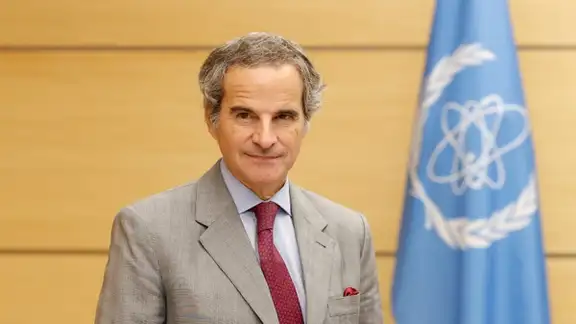
Iran’s nuclear negotiations have stalled, with International Atomic Energy Agency Director General Rafael Grossi saying the issue has effectively fallen behind the uncertainty surrounding the Strait of Hormuz.
In an interview with Argentine newspaper Clarín, Grossi said Iran’s enriched uranium is “essentially in the same place” where it was during the 12-day war.
He said Iran’s nuclear facilities had suffered significant damage and that reconstruction of some infrastructure may have begun, but the IAEA does not have firm evidence to confirm such activity.
Grossi stressed that Iran’s nuclear file remains one of the major unresolved international issues and said the agency is ready to resume its work in Iran as soon as possible.
He said the IAEA remains in contact with both the United States and Iran. According to Grossi, however, Iranian officials have told the agency that progress on the nuclear issue will not be possible unless the broader negotiating process changes.
The comments place the nuclear issue within a wider regional security context. The Strait of Hormuz is a critical route for global energy supplies, meaning any serious instability there could affect regional security, energy markets and the calculations of the parties involved in negotiations.
The most immediate concern for international nuclear monitoring is the lack of a complete picture of Iran’s nuclear activities following the damage to its facilities. Limited access and insufficient information make it harder for the IAEA to assess the status of nuclear material and infrastructure.
From a Nimruz perspective, the significance of Grossi’s remarks lies less in the claim that negotiations are temporarily stalled than in the monitoring gap surrounding Iran’s nuclear program. Without reliable access to facilities and nuclear material, international assessments become more difficult precisely when regional tensions are already increasing.
The result is a fragile situation in which diplomacy, nuclear verification and regional security are increasingly interconnected. Until the IAEA can restore meaningful access and the broader security situation becomes clearer, uncertainty over Iran’s nuclear program is likely to remain a major factor in both international diplomacy and Middle Eastern security.