

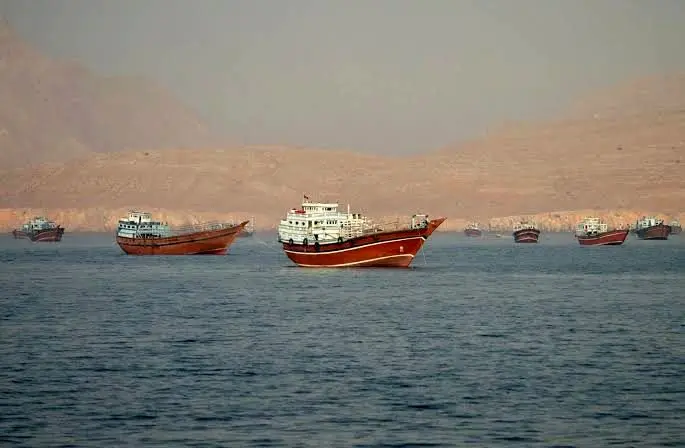
Commercial vessel traffic through the Strait of Hormuz fell to its lowest level in five weeks on Sunday, according to shipping data, as escalating military tensions between the United States and Iran continue to raise concerns about the security of one of the world’s most important energy routes.
Reuters, citing data from maritime analytics firm Kpler, reported that only six vessels transited the Strait of Hormuz during the day, marking the lowest daily total recorded in the past five weeks.
Among the vessels were the supertanker Humanity, carrying approximately two million barrels of Iranian crude oil, and the tanker Captain Andreas, transporting around 500,000 barrels of refined petroleum products from Kuwait. Tracking data also showed that three empty oil tankers entered the Persian Gulf to load crude cargoes.
Maritime tracking information indicated that a number of tankers switched off their automatic identification systems (AIS) while passing through the Strait of Hormuz. In addition, no liquefied natural gas (LNG) carriers were recorded entering the waterway over the weekend.
The developments come as the U.S. Central Command (CENTCOM) says it has launched a new wave of strikes against targets in Iran aimed at reducing Tehran’s ability to attack commercial shipping.
Meanwhile, Iran’s Islamic Revolutionary Guard Corps (IRGC) said its naval forces had intercepted two vessels in the Strait of Hormuz after their identification systems were disabled. The IRGC did not identify the ships or provide further details.
The competing claims made by the United States and Iran could not be independently verified. However, the continued military tensions have intensified concerns over the safety of international shipping and the stability of global energy supplies through the strategically vital Strait of Hormuz.