
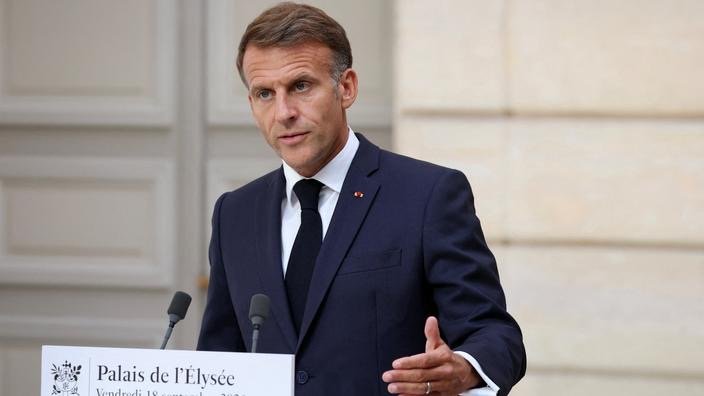
French President Emmanuel Macron used his address to the United Nations General Assembly to deliver a broad warning about the credibility of the international order, placing the wars in Gaza and Ukraine within a common framework of sovereignty, civilian protection and the right of peoples to determine their own future.
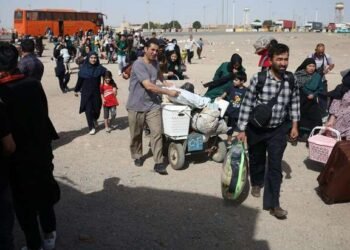
Macron sharply criticized what he described as the international community’s insufficient response to the humanitarian situation in Gaza. He said that despite diplomatic efforts and repeated claims that peace is being pursued, humanitarian assistance has still not reached Gaza at the level required, while the humanitarian situation remains deeply concerning.
The French president also pointed to the West Bank, where he said violations of Palestinian rights continue. He stressed that the legitimate rights of the Palestinian people, including their right to exist and determine their own future, must be respected.
At the same time, Macron linked Palestinian rights to Israel’s long-term security. His position was that security cannot be separated from a political framework capable of providing both Israelis and Palestinians with lasting stability.
Macron also warned against arguments that Israel’s security requires violations of the sovereignty of neighboring states. He described such an approach as a potentially decisive mistake, arguing that actions that weaken regional sovereignty could ultimately undermine both regional stability and Israel’s own security.
The French president extended the same sovereignty principle to Lebanon. He said only a fully sovereign Lebanese state can decide on the disarmament of Hezbollah and guarantee security for the Lebanese people and neighboring countries.
On Syria, Macron said the country must be able to restore its sovereignty and territorial integrity. He said France supports efforts aimed at building what he described as a free Syria.
The speech then turned to Russia’s war against Ukraine, which Macron presented as another major test of the principles contained in the UN Charter. He said Russia has continued its war against Ukraine for nearly five years and occupies part of the territory of a sovereign state.
Macron said France would continue supporting Ukrainians’ right to peace, security and the ability to determine their own future, while also working diplomatically to create conditions for negotiations between Moscow and Kyiv.
He proposed a halt to attacks on energy and civilian infrastructure as a possible confidence-building measure. Macron also pointed to a ceasefire in the Black Sea as a potential step that could facilitate the movement of grain and contribute to global food security.
The proposal is consistent with Macron’s recent diplomatic efforts over the war. On September 21, he said he had discussed with U.S. President Donald Trump the possibility of a moratorium on attacks affecting the energy sector in Russia and Ukraine, while stressing the need to strengthen Ukraine’s defensive capabilities.
The broader message of Macron’s UN address was that international law cannot be applied selectively. He argued that the principles of the UN Charter, including state sovereignty and peoples’ right to self-determination, should be respected consistently in Europe, the Middle East and Africa.
That position places Gaza and Ukraine within a single diplomatic framework: civilian protection, sovereignty and international rules should not depend on geography or political alliances.
The challenge for France, however, lies in translating that principle into policy while confronting competing interests among major powers, continuing wars and disagreements over how the international community should respond to Israel, Russia and armed groups across the Middle East.
Macron’s speech therefore went beyond criticism of individual conflicts. It was also an argument about the credibility of the international system itself: if sovereignty and international law are treated differently from one crisis to another, the authority of the rules designed to prevent conflict becomes increasingly difficult to sustain.