
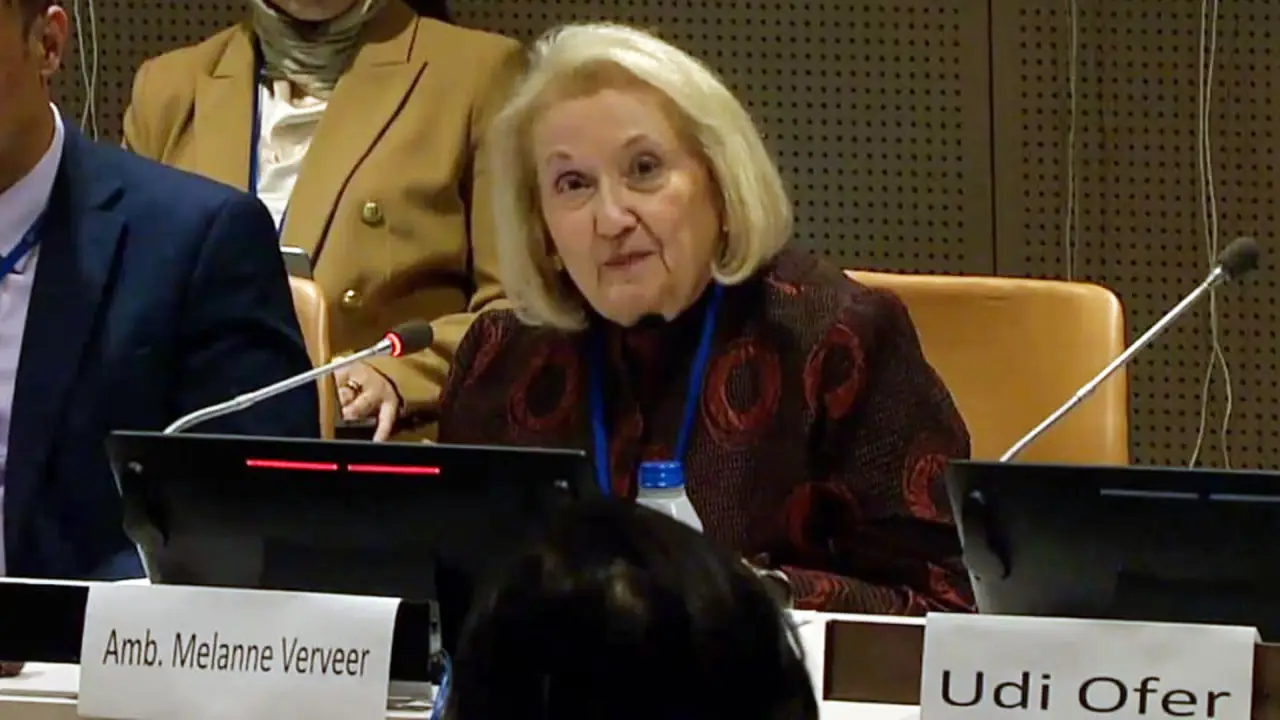
Former US Ambassador-at-Large for Global Women’s Issues Melanne Verveer has urged the international community to ensure that engagement with the Taliban does not lead to the normalization or eventual recognition of the group, while keeping Afghan women at the center of discussions about the country’s future.
Verveer made the remarks Monday, September 21, at a high-level side event titled “Women, Peace, Justice and National Reconciliation in Afghanistan” on the sidelines of the 81st session of the United Nations General Assembly in New York.
She argued that the international community has not drawn a sufficient distinction between engaging with the authorities controlling Afghanistan and supporting the Afghan people and civil society organizations.
“Any engagement with the Taliban must be such that it does not lead to normalization and ultimately recognition of the Taliban and what the group represents,” Verveer said.
She also criticized the reduction in international assistance to Afghanistan while the country continues to face humanitarian, economic and climate-related pressures. Verveer said the international response has not paid enough attention to the daily challenges facing Afghans or to the question of who should have a meaningful role in deciding how those challenges are addressed.
Women and girls were central to her criticism. Verveer pointed to restrictions affecting education, employment, public participation and freedom of movement, arguing that international engagement cannot separate economic and political discussions from their consequences for women.
She also referred to Taliban criminal regulations and cited a comparison involving penalties for mistreating animals and punishments for harming women. The comparison has previously appeared in analysis by Georgetown’s Institute for Women, Peace and Security, where Verveer serves as executive director.
Verveer warned that meetings between international actors and Taliban officials without sufficient attention to women’s rights could send a message that restrictions imposed on women are not a serious obstacle to political or economic engagement.
She also criticized aspects of the international dialogue process involving the Taliban, arguing that Afghan women have not always had meaningful participation. According to Verveer, some UN officials have responded that certain discussions focus on issues such as economics and trade.
She rejected the idea that such subjects can be separated from women’s rights, arguing that decisions about Afghanistan’s economy, trade and political future inevitably affect women and should therefore include them.
The broader event reflected a similar position. Organizers said sustainable peace in Afghanistan requires more than a reduction in armed conflict and depends on inclusive institutions, justice, accountability, human rights and the full and equal participation of women in political processes.
Verveer also criticized changes in diplomatic terminology used to describe the Taliban, arguing that changing titles without changing the principles of engagement or ensuring women’s participation in decision-making does not by itself produce a substantive change.
Her comments come five years after the Taliban returned to power, during which restrictions on women and girls have remained a central issue in international discussions about Afghanistan. A May 2026 assessment by Georgetown’s Institute for Women, Peace and Security described the restrictions as systematic and highlighted their effects on education, employment and public life.
Verveer and the institute have also repeatedly called for greater international support for Afghan women and for accountability over alleged human rights violations.
The debate now centers on a difficult policy question: how the international community can engage with the authorities controlling Afghanistan to address humanitarian, economic and security concerns without allowing that engagement to be interpreted as political normalization of policies that restrict women’s rights.
Verveer’s position is that the issue cannot be reduced to the terminology or format of diplomatic engagement. In her view, the participation of Afghan women in decisions about peace, justice, the economy and the country’s political future is a central test of whether international engagement contributes to an inclusive future for Afghanistan.
The practical impact of this approach, however, depends on how governments and international institutions balance engagement with the authorities in Kabul against pressure over human rights and the inclusion of Afghan women in political processes.