
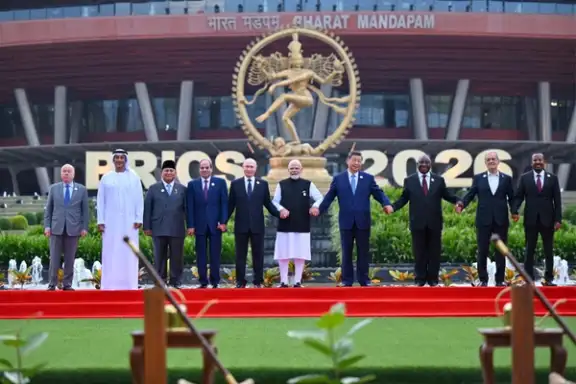
Chinese President Xi Jinping has called for deeper economic and technological cooperation among BRICS members and partner countries, putting artificial intelligence, trade and investment at the center of China’s proposals at the group’s annual summit in New Delhi.
Speaking on Sunday, September 13, Xi said the future success of BRICS depends on building stronger foundations for practical cooperation. He urged members to work more closely to stabilize industrial and supply chains and move toward a more integrated market.
China also plans to launch a BRICS initiative on artificial intelligence, according to Xi. The proposal would focus on joint development of language models, AI training, and broader access to AI tools and resources.
The initiative is significant because advanced technology has increasingly become a central element of economic competitiveness and strategic power. If BRICS countries turn the proposal into shared investment, research and technology access, it could give members greater capacity to develop AI outside the traditional centers of technological power.
Xi also proposed partnerships between special economic zones across BRICS countries and announced that China will host a BRICS Services Trade Forum next year, aimed at strengthening commercial and investment ties.
BRICS has expanded well beyond its original five members — Brazil, Russia, India, China and South Africa — with Iran, Indonesia, Egypt, Ethiopia and the United Arab Emirates among the countries that have joined the grouping. The bloc also has ten partner countries across Asia, Africa, Latin America and the Middle East.
China and Russia have at times referred to the broader network of members and partners as “Greater BRICS,” reflecting an effort to expand the group’s economic and political reach beyond its original core.
India, which holds the BRICS presidency in 2026, and China, which is due to take over the presidency next year, have both emphasized stronger cooperation among members and a larger role for BRICS in the international system.
Indian Prime Minister Narendra Modi said solutions developed through BRICS should not be limited to the group’s members but should also be designed to benefit countries across the wider non-Western world. Russian President Vladimir Putin, meanwhile, argued that BRICS could contribute to a fairer and more multipolar international order and called for greater use of the group’s economic strengths in joint cooperation.
The summit is also taking place against the backdrop of heightened tensions in the Middle East. BRICS members expressed deep concern over the escalation in the region in a joint statement and called for “maximum restraint.” Iran and the United Arab Emirates supported the declaration.
On the sidelines of the summit, Iranian President Masoud Pezeshkian met with the Abu Dhabi crown prince, creating a high-level channel between Iran and the UAE at a time of increased regional tensions. The two sides discussed de-escalation, regional stability, peace and development.
From the perspective of Nimruz, the broader significance of the summit lies in the way BRICS is increasingly attempting to connect economic cooperation with technology and global political influence. China’s AI proposal goes beyond a traditional trade agenda: it points toward a possible effort to build shared technological capacity among a diverse group of emerging and major economies.
But turning that ambition into a coherent economic bloc will be difficult. BRICS members have different economic structures, strategic priorities and relationships with global markets. Their ability to cooperate on AI, investment and supply chains will therefore depend not only on political declarations but on concrete financing, technology-sharing mechanisms and projects that produce measurable benefits.
For now, Xi’s proposals indicate that China wants BRICS to evolve from a broad political and economic grouping into a more practical network for cooperation among emerging and non-Western economies — while positioning technology, particularly artificial intelligence, as one of the main pillars of that transformation.