
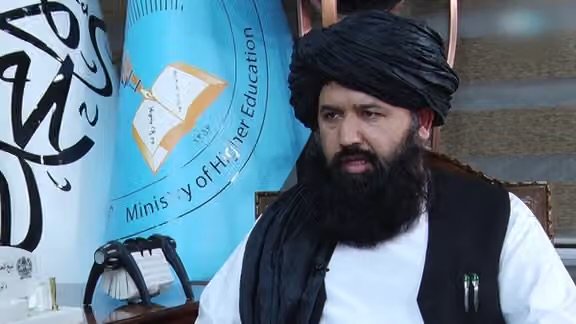
Taliban Higher Education Minister Neda Mohammad Nadeem says Taliban supreme leader Hibatullah Akhundzada was chosen through an “Ahl al-Hall wa al-Aqd” council and that no one has the right to oppose him, offering a direct insight into the group’s stated view of political legitimacy and authority.
Nadeem made the remarks on Wednesday at Kabul Polytechnic University during a ceremony honoring top students in an examination on Akhundzada’s decrees and welcoming new students.
He urged people not to judge the Taliban system by the actions of what he described as “biased and corrupt” individuals within the administration. He did not identify the people he was referring to.
Nadeem said opposition to the Taliban system is not permissible because, in his description, its legitimacy does not come from a popular vote but is “divine.” He also said that the Taliban system differs fundamentally from the previous republic, arguing that its emir is selected through an “Ahl al-Hall wa al-Aqd” process and that the Quran and Prophetic traditions are the sources of legislation.
He added that people have no right to oppose those laws and that obedience to the emir is obligatory.
The Taliban use the term “Ahl al-Hall wa al-Aqd” to refer to religious scholars, elders and influential figures who consult and make decisions on major issues, including the selection or endorsement of a leader.
The Taliban invited a number of religious scholars to Kabul in June 2022 to pledge allegiance to Akhundzada. However, the precise process through which Akhundzada initially became the Taliban’s leader, including the composition and selection of the body that supposedly represents “Ahl al-Hall wa al-Aqd,” has not been publicly established in a transparent and independently verifiable manner.
Nadeem contrasted this system with the previous republic, saying presidents were elected by a majority vote but that laws could be made according to individual preferences and potentially conflict with Islamic principles. He argued that opposition to such a system was necessary.
The remarks come after the Taliban abandoned the constitution of the former republic following their return to power in 2021. They have yet to introduce a new constitution establishing a broadly defined and publicly accountable framework for the country’s political structure.
The central issue raised by Nadeem’s comments is therefore not simply how Akhundzada became leader. It is who has the authority to select the members of the “Ahl al-Hall wa al-Aqd,” how those members are chosen, and on what basis their decision can be considered representative of the Afghan population.
From a Nimruz perspective, Nadeem’s statement is significant because it makes explicit a fundamental difference between electoral and Taliban-defined legitimacy. Under the former republic, political authority was formally tied to elections; the Taliban say their legitimacy comes from a religious framework rather than a popular mandate.
That position also has direct implications for political accountability. If opposition to the emir and the system is considered impermissible, while the mechanism for selecting the leader is not publicly transparent, the space for citizens to influence political leadership or challenge decisions remains sharply limited.
The remarks therefore point to a broader unresolved question about Afghanistan’s political future: what formal role, if any, will ordinary citizens have in choosing leaders, shaping laws and holding those in power accountable under the Taliban system?