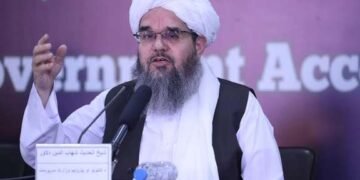

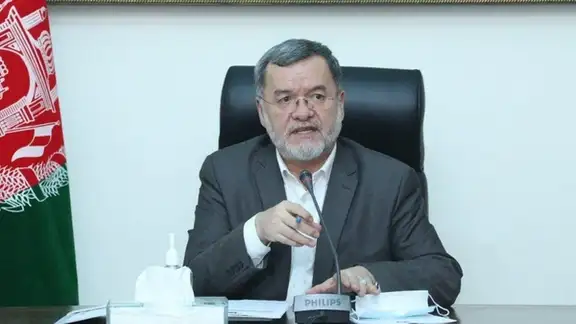
Sarwar Danish, former vice president of Afghanistan, has called for the establishment of a “government in exile” as a higher-level political authority capable of helping prepare the country for a transitional period.
Speaking Sunday at a virtual conference marking five years since the Taliban’s return to power, Danish said Afghanistan needs a political framework capable of facilitating a transfer of power and creating a system based on the will of the people.
The conference was organized by the National Assembly for the Salvation of Afghanistan and the High Council of National Resistance for the Salvation of Afghanistan.
Danish described the Taliban as an authoritarian movement that supports what he called gender apartheid, while stressing that opposition to the group should not be interpreted as opposition to any particular ethnic group, culture or language.
“What we oppose is the logic of monopoly,” he said.
The former vice president warned that the collapse of the Taliban alone would not resolve Afghanistan’s problems. He argued that unless the underlying causes of the country’s political crisis are addressed, Afghanistan could once again fall into a cycle of violence and civil war.
Referring to Afghanistan’s political history, Danish said the structure and substance of political systems have repeatedly played a central role in the country’s crises. He argued that political authoritarianism has existed in different forms and that one form of authoritarianism should not simply be replaced by another.
Danish also called for greater decentralization of Afghanistan’s political system. He identified the delegation of authority to local administrations, regional autonomy and federalism as possible mechanisms for distributing political power.
He argued that a significant part of Afghanistan’s destruction has been linked to ideology and extremism within political systems, which, he said, have restricted people’s freedoms.
Danish acknowledged the distinct historical and geographical identities of Afghanistan’s various communities but stressed that all citizens should enjoy equal rights.
He said his preferred political model was a form of “religious democracy,” which, according to him, should guarantee civil liberties and freedom of expression, ensure equal citizenship, distribute power fairly and provide opportunities for broad political participation.
Danish also argued that authoritarian political movements should not regard themselves as possessing an absolute monopoly on truth, emphasizing that political authority must ultimately be returned to the people.
His proposal for a government in exile comes five years after the Taliban returned to power, as opposition figures continue to debate how Afghanistan’s political system should change, how a transition of power could take place and what form an inclusive political structure should ultimately take.
The proposal also raises a broader question for Afghanistan’s opposition: whether a government in exile could develop sufficient political legitimacy and coordination to influence the country’s future, or whether divisions among opposition groups would limit its effectiveness.