

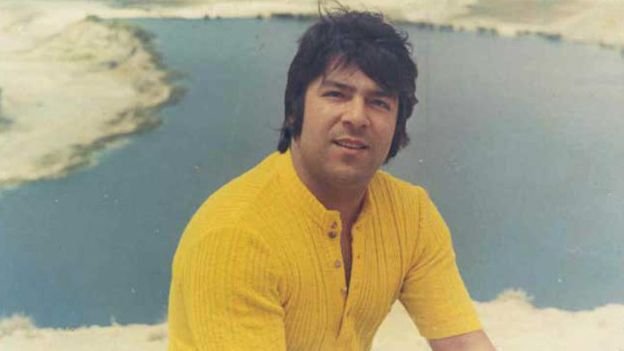
It began as an ordinary working day at Afghanistan’s National Radio. Ahmad Zahir, already one of the country’s most celebrated singers, arrived at the studio to record a song that he and the musicians had rehearsed in advance.
But an unexpected event would change the course of that day—and, according to a well-known account, give birth to one of the most memorable songs in Afghan music history.
According to Ghaus Zalmai, a former journalist at Afghanistan’s National Radio and Television, a staff member entered the studio during the session and informed Ahmad Zahir that someone was waiting outside with a message for him.
The singer stepped out of the studio. A few minutes later, he returned carrying a piece of paper and wearing a visibly saddened expression.
To the surprise of everyone present, Ahmad Zahir told the musicians that he no longer wanted to record the song they had prepared. Instead, he wished to perform a completely different piece.
The decision shocked the orchestra and studio staff because none of the musicians had rehearsed the new composition.
Despite the lack of preparation, Ahmad Zahir proceeded with the recording. That day, he performed and recorded the song:
“Emshab Be Qessa-ye Del-e Man Goosh Mikoni,
Farda Mara Cho Qessa Faramoosh Mikoni”
(Tonight You Listen to the Story of My Heart,
Tomorrow You Will Forget Me Like a Story)
The lyrics were written by renowned Iranian poet Houshang Ebtehaj (Sayeh), while the music was composed by Salim Sarmast.
Ghaus Zalmai later recalled asking Ahmad Zahir what had happened after the recording was completed. According to his account, the singer did not answer. Instead, a tear rolled down his face.
The story suggests that the letter delivered to Ahmad Zahir that day was connected to his separation from Najia, his first wife—a deeply personal event that reportedly left a lasting emotional impact on him.
Whether remembered as fact, legend or a blend of both, the story has become one of the most widely shared memories associated with Ahmad Zahir’s life and career.
For many admirers, it reflects the profound emotional depth that defined his music. His songs often explored themes of love, longing, heartbreak and human vulnerability—qualities that continue to resonate with listeners decades after his death.
Today, Ahmad Zahir remains one of the most influential cultural figures in Afghanistan, and stories such as this continue to strengthen his place in the country’s collective memory and musical heritage.