
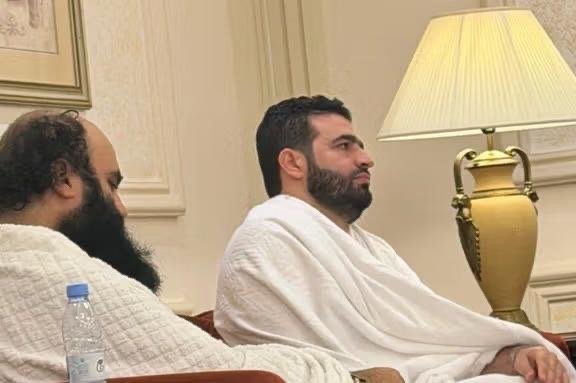
A meeting between Taliban Interior Minister Sirajuddin Haqqani and Syrian Interior Minister Anas Khattab on the sidelines of the Hajj pilgrimage in Saudi Arabia has drawn attention amid the absence of formal diplomatic relations between the two sides.
The meeting was disclosed by Mohammad Jalal, an adviser to the Taliban interior minister, who shared a photograph of the gathering on X. The image showed that Abdul Haq Wasiq, head of the Taliban intelligence agency, and Hussein Salama, chief of Syria’s intelligence service, also attended the meeting.
No details were released regarding the topics discussed, possible agreements, or the exact timing of the meeting. However, the participation of senior security and intelligence officials from both sides has fueled speculation about the significance of the talks.
The meeting comes despite the fact that Syria and the Taliban administration do not maintain official diplomatic relations. Damascus, like most governments around the world, has not formally recognized the Taliban government since it returned to power in Afghanistan in 2021.
Nevertheless, signs of limited engagement have emerged in recent months. In early 2025, Taliban Prime Minister Mohammad Hassan Akhund congratulated Syrian interim President Ahmad al-Sharaa on his appointment and expressed hope for stronger relations between Afghanistan and Syria.
Despite those signals, contacts between Taliban officials and Syria’s new leadership have remained limited, and Damascus has not announced any formal steps toward establishing diplomatic ties with the Taliban administration.
The presence of intelligence chiefs alongside the two interior ministers suggests that the meeting may have involved discussions extending beyond symbolic diplomacy. Security cooperation, regional developments, intelligence-sharing mechanisms, and broader geopolitical issues are among the subjects analysts may consider possible areas of discussion, although neither side has confirmed the agenda.
The meeting also comes at a time when the Taliban are seeking to expand their international engagement and reduce political isolation, while Syria’s new leadership is attempting to redefine its regional position following major political changes in the country.
NIMRUZ ANGLE
The significance of the meeting lies less in the fact that it occurred and more in who attended it. The involvement of senior intelligence officials from both sides indicates that security considerations may be becoming an important element of future contacts. Even without formal diplomatic recognition, both governments appear interested in maintaining channels of communication that could serve broader regional interests.
FINAL ANALYSIS
While no official outcomes have been announced, the meeting reflects a gradual shift in regional diplomacy involving governments that remain outside full international acceptance. For the Taliban, every high-level engagement helps reduce diplomatic isolation. For Syria’s new leadership, maintaining flexible regional contacts may provide additional strategic options as it seeks broader legitimacy. Whether the talks lead to practical cooperation remains unclear, but the encounter suggests that informal engagement between Kabul and Damascus is expanding despite the absence of formal diplomatic relations.