
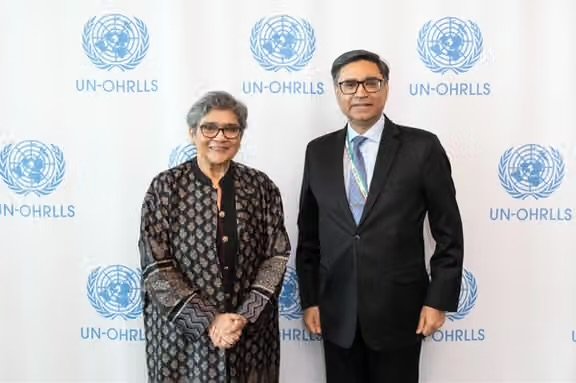
Rabab Fatima, the United Nations Secretary-General’s new Special Representative for Afghanistan and incoming head of the UN Assistance Mission in Afghanistan, has met India’s Foreign Secretary Vikram Misri in New York ahead of formally taking up her post in Kabul.
The meeting took place on the sidelines of the 81st session of the UN General Assembly and comes as Fatima begins consultations with regional and international actors whose policies are closely linked to Afghanistan.
According to India’s Ministry of External Affairs, Misri emphasized the need for the international community to maintain its focus on the humanitarian needs of the Afghan people and expressed appreciation for UNAMA’s role in Afghanistan.
India also reaffirmed its commitment to working with UNAMA, underscoring New Delhi’s continued interest in the United Nations’ role in international engagement on Afghanistan.
Fatima welcomed the meeting and expressed appreciation for India’s continued support for the UN Office of the High Representative for the Least Developed Countries, Landlocked Developing Countries and Small Island Developing States.
She also highlighted India’s role as co-chair of the Group of Friends of Landlocked Developing Countries and expressed hope that New Delhi would continue its support.
The meeting is significant for Fatima because she has not yet formally begun her assignment in Afghanistan. Her appointment was announced by UN Secretary-General António Guterres on 15 July 2026, when he named her as his new Special Representative for Afghanistan and head of UNAMA, succeeding Roza Otunbayeva.
Fatima brings more than three decades of experience in national and international public service and bilateral and multilateral diplomacy. Before taking the Afghanistan portfolio, she served as the UN Under-Secretary-General and High Representative for the Least Developed Countries, Landlocked Developing Countries and Small Island Developing States.
She previously served as Bangladesh’s Permanent Representative to the United Nations in New York and as ambassador to Japan, as well as holding senior positions in Bangladesh’s foreign ministry and international organisations.
Her arrival at UNAMA comes as Afghanistan continues to face interconnected humanitarian, economic, human rights and political challenges. UNAMA’s mandate was extended by the Security Council in June 2026 for another year, through 17 June 2027, with the mission retaining responsibilities related to political engagement, human rights, humanitarian coordination and support for regional cooperation.
The mission is also operating in an increasingly complex regional environment. Relations between Afghanistan and Pakistan remain strained, while countries including India, Qatar, Türkiye and the Central Asian states continue to maintain different forms of diplomatic engagement on Afghanistan.
India has consistently emphasized the importance of international and regional coordination on Afghanistan and has participated in UN-led and regional discussions concerning the country. Its engagement includes participation in the UNAMA working groups on counter-narcotics and private-sector development.
For Fatima, therefore, the meeting with Misri was part of a broader diplomatic phase preceding her arrival in Kabul. Recent meetings with other regional and international officials at the UN General Assembly have similarly focused on Afghanistan and the future implementation of UNAMA’s mandate.
The significance of this early outreach lies in the role regional cooperation is likely to play in the new UNAMA leadership’s work. The mission cannot address Afghanistan’s political, humanitarian and security challenges through engagement with Kabul alone; its effectiveness also depends on maintaining dialogue with neighbouring and influential states.
Fatima’s immediate task will be to translate those diplomatic contacts into a working framework for UN engagement with Afghanistan while maintaining the mission’s mandate on humanitarian needs, human rights and political dialogue.
Her consultations in New York therefore offer an early indication of the diplomatic environment in which she will begin her tenure. The central challenge will be balancing engagement with the Taliban authorities, coordination with regional states and international partners, and the UN’s responsibilities toward the Afghan population.