
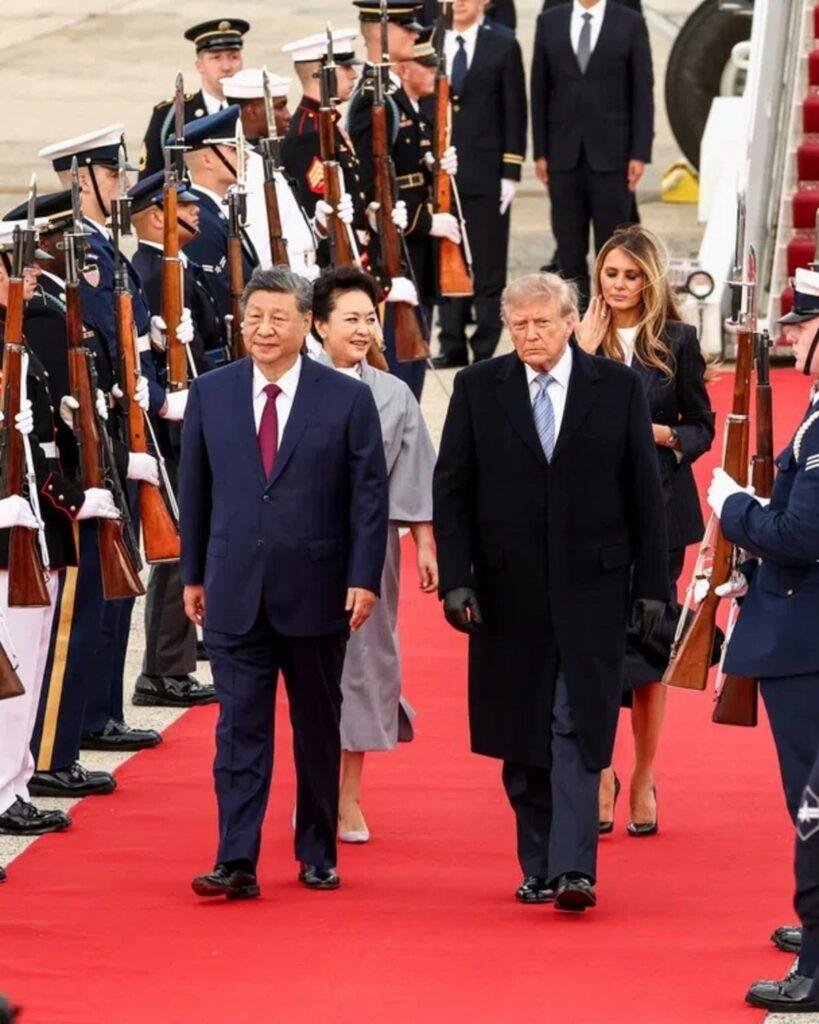
US President Donald Trump gave Chinese President Xi Jinping an unusually high-profile welcome at Joint Base Andrews in Maryland on Wednesday, opening a three-day state visit that places trade, technology and major geopolitical disputes at the center of US-China diplomacy.
Trump and First Lady Melania Trump personally greeted Xi and his wife, Peng Liyuan, on the tarmac as a military band played the American and Chinese national anthems. A 21-gun salute, a military honor guard and a flyover by two B-1 bombers formed part of the ceremony.
The planeside welcome was unusual for a visiting foreign leader. The main ceremonial reception was scheduled for Thursday at the White House, where Trump is due to hold talks with Xi before hosting a state dinner.
The symbolism of the arrival contrasts with the difficult issues facing the two governments.
Trade remains one of the most immediate subjects. Washington and Beijing have moved away from the broad tariff escalation that characterized their recent trade conflict, and the two sides have agreed to extend their current trade truce until January 10, 2027.
The extension provides additional time for negotiations, but it does not resolve the underlying disputes over tariffs, market access, technology restrictions, agricultural purchases and critical minerals.
Artificial intelligence is another increasingly important area of competition and potential cooperation. The United States and China are competing for leadership in advanced AI while also discussing mechanisms for managing risks associated with increasingly capable systems.
Technology restrictions are closely connected to the broader strategic rivalry. Washington continues to seek limits on China’s access to some advanced technologies, while Beijing has resisted measures it views as attempts to constrain its technological development.
Taiwan is likely to remain among the most sensitive subjects.
China considers Taiwan part of its territory and opposes US military support for the island. Washington maintains extensive unofficial relations with Taiwan and has continued to provide military support, although the timing of some recent arms sales has become part of the broader US-China negotiations.
Iran is another major issue on the summit agenda. China maintains important economic relations with Iran, while the United States is seeking to manage the wider consequences of the conflict involving Tehran.
Washington is also pressing Beijing over its purchases of Iranian oil and its broader economic relationship with Iran. China, meanwhile, has signaled an interest in stability and has sought to maintain its strategic and economic ties with Tehran.
Critical minerals and rare earths are also central to the economic relationship. China remains a major player in the global supply of rare earth elements that are important to advanced manufacturing, defense and technology industries, making the issue a significant point of leverage in negotiations.
Agricultural trade and potential purchases of US products are another area where the two governments are looking for practical agreements that could help stabilize the economic relationship.
The stakes extend well beyond the bilateral relationship.
The United States and China are the world’s two largest economies and major military powers. Their decisions on tariffs, advanced technology, Taiwan, critical minerals and geopolitical conflicts can affect global markets, supply chains and international security.
The ceremonial welcome at Andrews therefore carries a political message of its own. Both governments have an interest in demonstrating that competition does not necessarily have to lead to a complete breakdown in relations.
But the pageantry does not remove the underlying disagreements.
The substantive test of the visit will come in the negotiations themselves: whether Trump and Xi can extend economic stability while managing disputes over technology, Taiwan, Iran and strategic competition.
For now, the summit represents an attempt to place guardrails around one of the world’s most consequential rivalries. The unusually elaborate welcome signals the importance both sides attach to direct engagement, while the agenda shows how much remains unresolved between Washington and Beijing.