
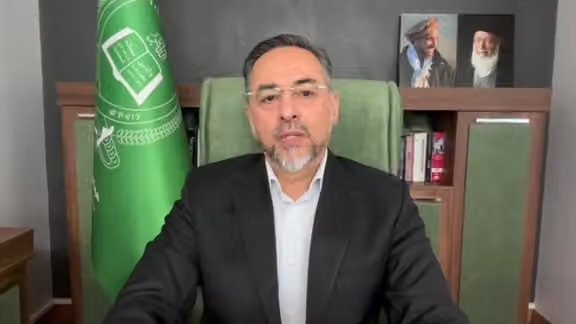
Salahuddin Rabbani, leader of Jamiat-e Islami Afghanistan, has urged Taliban members in Badakhshan and northern Afghanistan who joined the group to put the interests of the Afghan people ahead of those of the Taliban and to remain accountable for the group’s actions.
Speaking Sunday at a ceremony marking Martyrs’ Week, Rabbani addressed Taliban members from the region and accused them of acting against national interests.
“You are unpatriotic, and history will place a stain of shame on your foreheads,” Rabbani said. He added that Afghans would judge their actions and that “injustice never lasts.”
The ceremony marked the 15th anniversary of the killing of Burhanuddin Rabbani, the former head of the Islamic State of Afghanistan, and the 25th anniversary of the assassination of Ahmad Shah Massoud. A number of former mujahideen leaders and political figures attended the event.
Rabbani also called on young Afghans to work toward strengthening national unity and to avoid fueling disputes over provincial and regional identities.
He accused the Taliban of treating Afghanistan over the past five years as “a conquered land” and criticized what he described as excessive extraction and irresponsible exploitation of the country’s natural resources. He characterized the situation as the “deliberate burning of Afghanistan.”
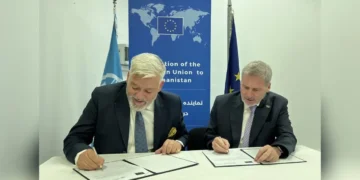
Rabbani also referred to an oil contract in western Afghanistan signed between the Taliban and Saudi company Delta International, at whose signing ceremony Zalmay Khalilzad was present. Referring to Khalilzad’s role in the Doha agreement, Rabbani warned companies involved in such arrangements that their cooperation could carry legal consequences.
He did not limit his criticism to the Taliban’s policies on women and girls. Rabbani said reopening secondary schools for girls is necessary but should not be the sole benchmark for resolving Afghanistan’s crisis or determining whether the Taliban should be accepted.
He argued that Afghanistan’s political crisis and discrimination against ethnic groups must be addressed at a fundamental level, saying the country’s problems cannot be reduced to the reopening of girls’ schools.
Rabbani’s remarks reflect a broader argument among political opponents of the Taliban that Afghanistan’s future cannot be defined solely through the question of women’s education. Political representation, ethnic inclusion, management of natural resources and the structure of governance are also becoming central elements of the debate over the country’s political future.
From Nimruz’s perspective, that broader framing matters because the dispute over the Taliban’s legitimacy is ultimately tied not only to social restrictions but also to who controls political power, who participates in decision-making and how Afghanistan’s national resources are managed.
At the same time, Rabbani’s remarks are political criticism from an opposition figure and do not by themselves establish the allegations he made regarding resource exploitation or the legal exposure of companies. The significance of his statement lies primarily in the issues he is putting forward: accountability, political inclusion, national unity and control over Afghanistan’s resources.
The emerging debate therefore extends beyond whether individual Taliban policies change. It concerns whether Afghanistan can develop a political order in which competing communities have meaningful representation and in which the country’s resources and institutions are managed in a way that commands broader public legitimacy.