
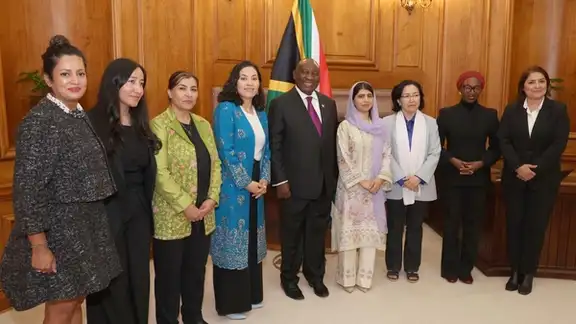
South African President Cyril Ramaphosa has met with girls’ education advocate Malala Yousafzai and a group of Afghan women activists, with the meeting focusing on support for Afghan women and international efforts to confront what activists describe as “gender apartheid” under Taliban rule.
The South African government said on Sunday, August 9, that Afghan women at the meeting called on Pretoria to support international efforts aimed at addressing gender discrimination in Afghanistan.
According to a statement from the South African government, participants also stressed that Afghan women must be placed at the center of global efforts to pursue justice and accountability.
Following the meeting, Malala Yousafzai thanked Ramaphosa on X for what she described as his empathy and meaningful engagement with Afghan women.
Yousafzai said Afghanistan is approaching the fifth anniversary of Taliban rule, a period she said has been marked by sweeping restrictions on women’s rights and the exclusion of girls from education.
She also stressed the importance of South African support in pursuing justice and preventing the normalization of what she calls gender apartheid.
South Africa’s position is closely linked to its own history of resistance to racial apartheid. South African officials have previously argued that the country’s experience demonstrates how domestic resistance, combined with international solidarity, can help challenge systems of institutionalized discrimination.
South Africa’s representative to the United Nations Human Rights Council has also expressed support for campaigns against gender apartheid, arguing that the international community should not remain silent over the exclusion of Afghan women and girls from fundamental rights.
South Africa’s ambassador to London has previously described Taliban policies toward women as gender apartheid and a crime against humanity, saying South Africa’s experience could offer lessons for Afghanistan’s struggle.
The meeting comes as international efforts continue to secure formal recognition of gender apartheid as an international crime and increase pressure on the Taliban to lift restrictions imposed on Afghan women and girls.
The designation of the Taliban’s policies as “gender apartheid” remains part of an international legal and political campaign, while the Taliban have consistently rejected international criticism of their policies as interference in Afghanistan’s internal affairs.