
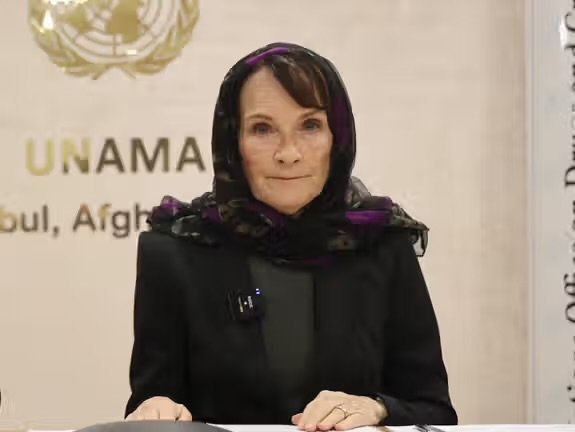
Georgette Gagnon, the acting head of the United Nations Assistance Mission in Afghanistan (UNAMA), has renewed the UN’s call for the Taliban to lift restrictions on girls’ education and allow girls to return to school at all levels.
During a visit to the Istalif district of Kabul Province, Gagnon toured a girls’ primary school and said Afghan girls should be able to continue their education and play a full role in the country’s development and future prosperity.
According to a video released by UNAMA, Gagnon also met local Taliban officials and community elders to discuss economic challenges, educational needs and local development priorities in the district.
She visited a computer laboratory established at the school with UN support and emphasized the importance of ensuring girls have access to information technology and digital skills.
Since returning to power in August 2021, the Taliban have barred girls from attending secondary school and, in December 2022, extended restrictions by prohibiting women and girls from studying at universities. Afghanistan remains the only country in the world where girls are denied access to both secondary and higher education.
According to the United Nations Educational, Scientific and Cultural Organization (UNESCO), more than 2.5 million Afghan girls are currently out of school. The agency has warned that if the restrictions remain in place, that number could exceed four million by 2030.
The United Nations Children’s Fund (UNICEF) has also warned that continuing the education ban could leave Afghanistan facing a shortage of more than 20,000 female teachers and 5,400 female healthcare workers by 2030. UNICEF says the restrictions are also likely to increase child marriage, reduce the number of qualified women professionals and contribute to higher maternal and infant mortality rates.
As of publication, the Taliban had not publicly responded to Gagnon’s latest appeal. The Taliban have previously maintained that restrictions on girls’ education are temporary and will be resolved in accordance with their interpretation of Islamic law, a position that continues to be rejected by the United Nations and much of the international community.