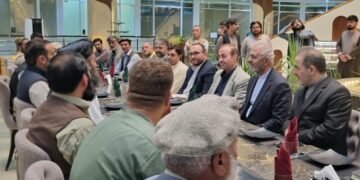

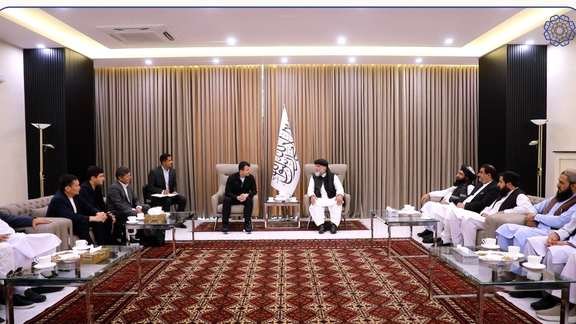
A high-level delegation of Uzbek government officials and private-sector representatives, led by Deputy Prime Minister Jamshid Khodjayev, arrived in Kabul on Saturday for a series of meetings focused on expanding economic cooperation between Afghanistan and Uzbekistan.
According to the Taliban’s Ministry of Industry and Commerce, the delegation was welcomed at Kabul International Airport by Acting Minister Nooruddin Azizi. The ministry said the visit includes meetings with Taliban officials, discussions with Afghan business leaders and participation in a bilateral trade forum.
Officials expect the talks to cover a broad range of economic issues, including increasing bilateral trade, promoting investment, improving commercial relations and strengthening cooperation between the private sectors of both countries.
Although Uzbekistan has not formally recognized the Taliban administration since its return to power in 2021, Tashkent has maintained economic engagement with Afghanistan and has repeatedly emphasized the importance of regional trade and practical cooperation.
Transport connectivity is expected to be a key topic during the visit. The proposed Trans-Afghan Railway project, which aims to link Central Asia with Pakistan through Afghanistan, remains one of the most significant joint infrastructure initiatives between the two sides.
Other areas of cooperation include expanding commercial activity through the Hairatan border crossing, facilitating the movement of traders, increasing collaboration in industry and agriculture, and reducing customs barriers.
Taliban and Uzbek officials have previously expressed their intention to increase bilateral trade. Uzbekistan exports electricity, food products, machinery, construction materials and industrial goods to Afghanistan, while Afghanistan exports agricultural products, dried fruits, carpets and selected raw materials to Uzbekistan.
The visit comes as the Taliban continue efforts to strengthen economic ties with neighboring countries and diversify Afghanistan’s regional trade routes, seeking to reduce reliance on traditional transit corridors, particularly those passing through Pakistan.