

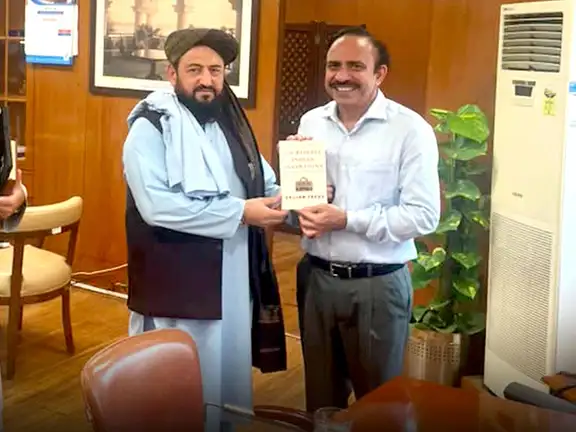
India has signaled readiness to cooperate with Afghanistan on urban wastewater management, sewage treatment facilities and technical training, as the Taliban-run Urban Water Supply and Sewerage Company seeks Indian expertise to improve sanitation infrastructure in Afghan cities.
The discussions took place during a visit to India by Mawlawi Ghulam Rahman Kazim, chief executive of Afghanistan’s state-owned Urban Water Supply and Sewerage Company. Kazim met Indian officials responsible for water and wastewater management and discussed possible areas of technical cooperation.
According to Afghanistan’s state-owned enterprises authorities, Kazim briefed the Indian side on the company’s existing services, infrastructure, technical capacity and requirements. He called for greater cooperation in modernizing wastewater systems and developing treatment facilities suited to Afghanistan’s conditions.
Indian officials presented their experience in urban water supply, sewage collection and wastewater treatment, including technologies and management practices used in New Delhi.
Indian officials also expressed readiness to cooperate in establishing wastewater treatment facilities, including decentralized and pond-based systems, as well as strengthening the professional and technical capacity of Afghan personnel.
The discussions also covered operational management, maintenance of facilities and technical training. Such cooperation, if implemented, could provide Afghan engineers and utility staff with access to technical experience from a country that has developed large-scale urban water and wastewater systems.
The Afghan delegation also visited the Okhla wastewater treatment plant in New Delhi during the trip. The visit was intended to familiarize Afghan officials with wastewater treatment technologies, operating practices and the management of treatment facilities.
During that visit, the Afghan side shared technical information concerning the Gulbagh wastewater treatment plant in Kabul, which is under construction. The two sides agreed to examine technologies and systems that could be adapted to Afghanistan’s environmental and infrastructure conditions.
The discussions come as Afghan cities face significant challenges in wastewater collection and treatment. Rapid urban growth, limited sewerage networks, reliance on septic systems and insufficient treatment capacity have increased pressure on municipal infrastructure.
Kabul faces particularly significant water and sanitation challenges. Population growth and pressure on groundwater resources have added to the need for more effective management of both drinking water and wastewater.
The Indian side’s willingness to share technical experience is therefore relevant beyond a single proposed project. Decentralized treatment systems could potentially be useful in areas where large centralized sewerage networks are difficult or expensive to construct.
However, the announcement of readiness to cooperate does not amount to a signed project agreement or confirmation that construction will begin immediately.
No specific financing package, project budget, implementation timetable or binding construction contract has been publicly announced in the official statements reviewed for the discussions.
That distinction is important because technical cooperation, feasibility studies and exchange of expertise are normally separate stages from financing, procurement and construction.
The initiative nevertheless adds another practical dimension to India’s engagement with Afghanistan. In recent months, India has continued contacts with Taliban authorities and Afghan institutions on economic, humanitarian and technical matters, while maintaining its broader diplomatic position on Afghanistan.
Water and wastewater management also provides an area of engagement that is primarily technical and public-service oriented. Such cooperation can create practical channels between institutions even when wider political questions surrounding Afghanistan remain unresolved.
For Afghanistan, access to external expertise could help address gaps in engineering capacity, treatment technology and urban sanitation planning. For India, technical cooperation offers another channel for maintaining engagement with Afghan institutions while contributing to infrastructure and public-service needs.
The immediate challenge will be turning the announced willingness to cooperate into concrete feasibility studies, financing arrangements, technical designs and projects that can be maintained over the long term.
The Kabul wastewater sector therefore remains at an early stage of potential India-Afghanistan cooperation. The key measure of progress will not be the announcement itself, but whether the two sides can translate technical discussions and site visits into funded, appropriately designed and operational wastewater facilities.