
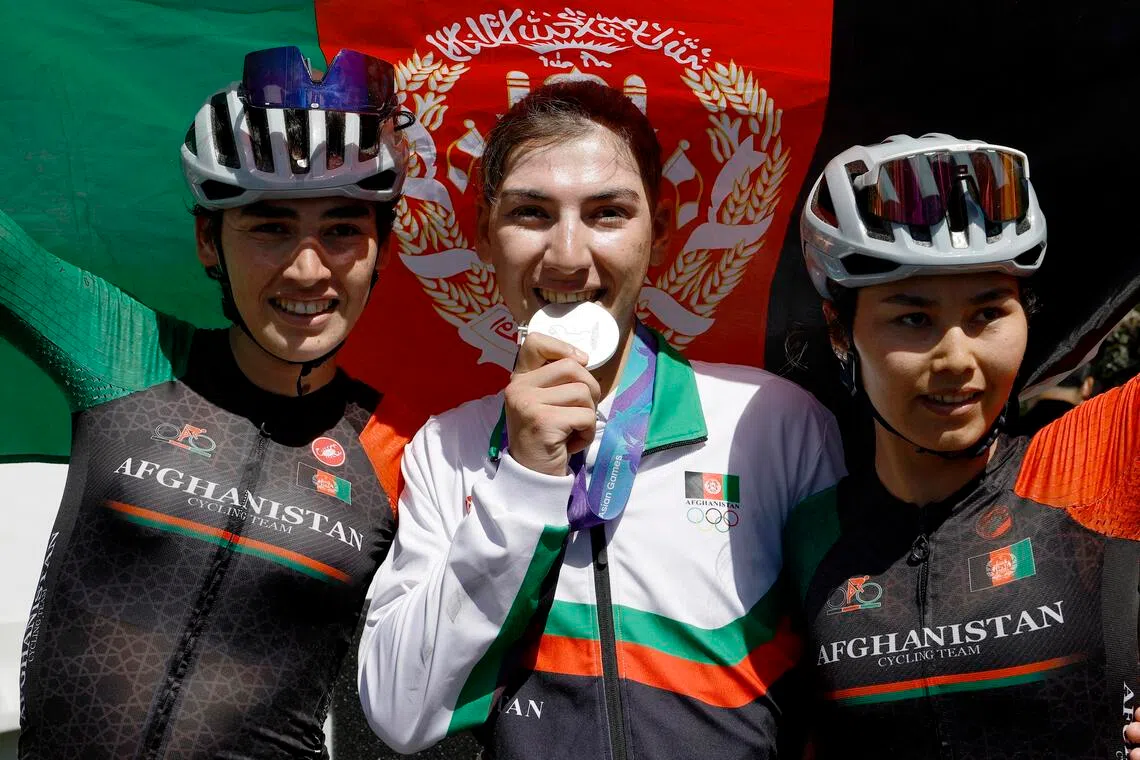
Afghan cyclist Fariba Hashimi won a silver medal at the Asian Games in Japan on Tuesday, September 22, 2026, marking a major achievement in a sporting journey that began under difficult social restrictions in Afghanistan.
For Hashimi, the medal represents more than a result on the cycling course. Her early career was shaped by barriers that made it difficult to train openly and pursue the sport she loved.
During the early years of her cycling career in Afghanistan, Hashimi faced social restrictions surrounding women’s participation in cycling. At times, she reportedly had to borrow bicycles to train. She also wore men’s clothing to avoid attention and continue practicing.
Years later, the same athlete has reached the podium at one of Asia’s major sporting competitions, securing silver for Afghanistan.
Hashimi has said she hopes her achievements will encourage Afghan women and girls not to abandon sport or their ambitions despite the restrictions they face.
Her journey also highlights the sharp contrast between Afghan women athletes competing internationally and the circumstances facing women and girls inside Afghanistan.
Since returning to power in 2021, the Taliban has imposed extensive restrictions on women and girls, including restrictions affecting education, employment, public participation and access to many areas of public life. These restrictions have also affected opportunities for women to participate openly in sport.
For Afghan female athletes competing abroad, international competitions have therefore become not only sporting platforms but also rare opportunities to represent Afghanistan on the global stage.
Hashimi’s silver medal adds to that broader story. Her result places an Afghan woman on an Asian sporting podium while drawing attention to the difficult path that many Afghan female athletes have had to navigate to continue their careers.
The significance of the achievement lies both in the medal itself and in the journey behind it: from borrowing a bicycle and finding ways to train discreetly in Afghanistan to competing at the highest level of Asian sport.
Hashimi’s success does not erase the barriers facing women athletes in Afghanistan, but it demonstrates what can be achieved when athletes are able to continue their careers and compete internationally.
For Afghanistan, the silver medal is a sporting achievement. For Hashimi and many Afghan women athletes, it is also a reminder that the pursuit of sport and personal ambition can continue despite the obstacles that once seemed to make that path impossible.