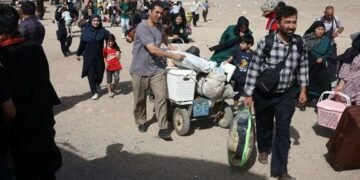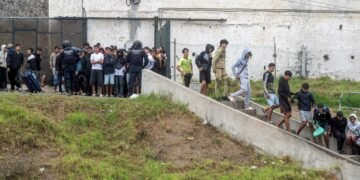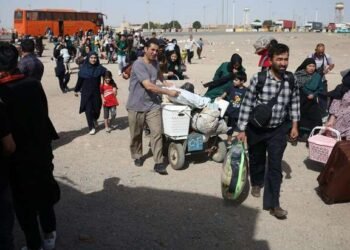

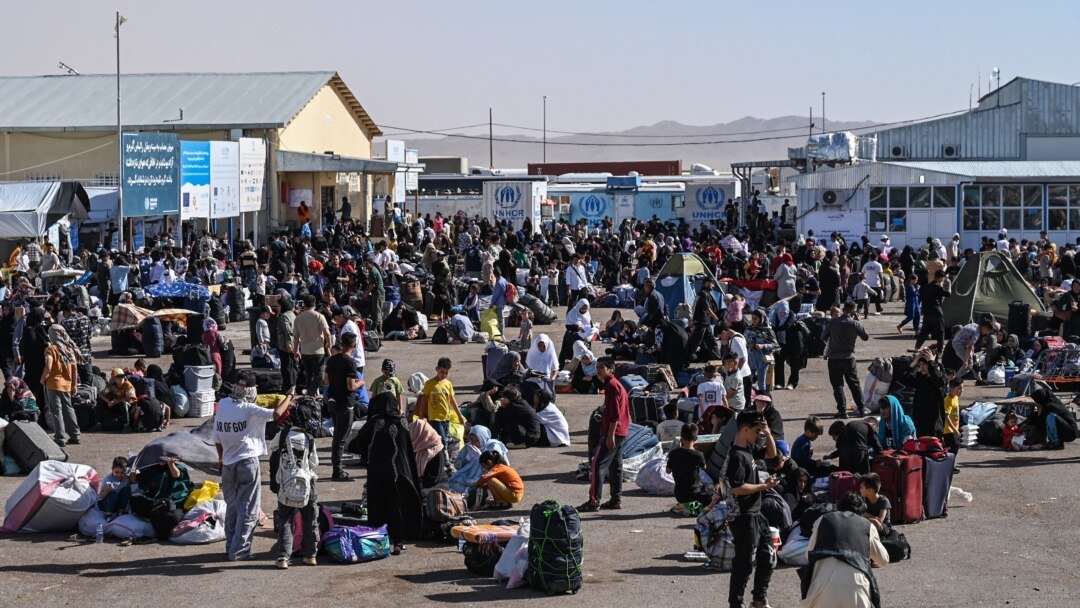
Thousands of Afghans are returning from Iran as a severe economic crisis erodes jobs and savings, forcing families who spent years building lives there to return to Afghanistan despite limited employment opportunities and extensive restrictions on women and girls.
A Reuters report based on interviews with returnees near Afghanistan’s western border says many Afghans had been unemployed for months before leaving Iran, while sharply rising living costs made remaining there increasingly difficult. Reuters reported that Iranian consumer prices had risen by nearly 90 percent year on year, while food inflation had reached about 130 percent, citing Iranian statistical data. The report also linked the worsening economic conditions to sanctions and restrictions associated with the US naval blockade. oai_citation:0‡Reuters
International Organization for Migration data cited in the report indicate that average incomes among Afghans who recently returned from Iran had fallen by roughly one-third compared with before the crisis, while only 29 percent still had savings. Reuters said the latest wave of returns differs from earlier movements because women and entire families now make up a larger share of those crossing back into Afghanistan. oai_citation:1‡Reuters
Mohammad Saeed, one of the returnees interviewed by Reuters, said his family had moved to Iran after the Taliban returned to power in 2021 but was now coming back to Afghanistan with almost nothing. He said the sharp decline in the value of Iran’s currency had wiped out more than two-thirds of the family’s savings. oai_citation:2‡Reuters
The scale of Afghan returns is already substantial. IOM reported that about 6.04 million Afghans returned from Iran and Pakistan between mid-September 2023 and May 30, 2026, with many returnees arriving with limited access to housing, livelihoods, services and protection. oai_citation:3‡DTM
At the Islam Qala crossing, Taliban official Abdul Ghani Qazizada told Reuters that between 20 and 40 families were entering Afghanistan voluntarily each day. He said many Afghan workers complained that wages in Iran were either unpaid or no longer sufficient to cover basic living costs. oai_citation:4‡Reuters
For women and girls, however, returning to Afghanistan carries consequences beyond the loss of employment and income. Girls above sixth grade remain excluded from formal secondary education and women face extensive restrictions on movement and participation in public life under Taliban rule. The Taliban says it upholds women’s rights in accordance with Islamic law.
The experience of Abdul Jabbar, a 44-year-old worker, illustrates the economic uncertainty facing some returnees. His family had lived in Iran for nearly four decades before returning after worsening conflict and the loss of employment opportunities. Two months after returning, he was still unemployed, and the family was living in a one-room mud house.
His 15-year-old daughter, Setayesh, who hopes to become a fashion designer, told Reuters that she wished she could return to Iran to continue her education and be with her friends. oai_citation:5‡Reuters
Some families are attempting to use their remaining savings to rebuild businesses in Afghanistan. Mohammad Saeed and his mother, Rezwana Jami, have bought equipment to restart their production of pizza cheese, a business they previously operated in Iran.
But even that effort comes with a significant social cost. Jami told Reuters that her 17-year-old daughter repeatedly tells her that after eight years of schooling, she is now simply staying at home. oai_citation:6‡Reuters
From the perspective of Nimruz, the significance of the latest return movement is that many families are not choosing between two stable alternatives. They are moving between two difficult economic and social environments: an Iran where inflation, unemployment and the collapse in the value of savings have reduced their ability to remain, and an Afghanistan where employment opportunities remain limited and women and girls face extensive restrictions.
خ
For families who return without savings, employment or access to education, returning home can therefore become the beginning of another crisis rather than the end of one. The challenge for Afghanistan is not simply to receive returning families, but to provide realistic pathways for them to rebuild their livelihoods — while the restrictions affecting women and girls make that recovery particularly difficult for many households.