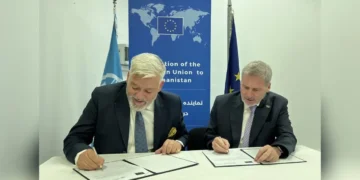


A former European Union diplomat in Afghanistan says al-Qaeda members remain present in the country but argues that the group is currently weakened and has limited capacity to inflict serious harm on the United States or Israel.
Michael Semple, a former EU diplomat in Afghanistan, made the assessment on Friday, September 11, in an interview with Afghanistan International. Speaking on the broadcaster’s “Discussion of the Day” program, he said al-Qaeda currently lacks significant operational capability.
“At present, al-Qaeda does not have much ability to cause harm to the United States or Israel,” Semple said.
Semple nevertheless warned that the security threat associated with the Taliban cannot be ignored. He argued that the Taliban could represent a broader security challenge because they control Afghanistan’s territory and have access to an extensive network of religious schools.
His assessment comes amid continued international concern over the presence of al-Qaeda members in Afghanistan. The distinction he draws is between the current operational capacity of al-Qaeda and the Taliban’s much broader territorial and social reach.
Al-Qaeda has moved far from the level of operational capability associated with the large-scale international attacks for which the group became known, according to Semple’s assessment. The Taliban, by contrast, exercise control over the country and maintain extensive structures that reach into Afghan society.
That difference broadens the debate over security threats originating from Afghanistan. The issue is not limited to whether an international terrorist network maintains a presence inside the country. It also concerns how territorial control, social influence and institutional networks could translate into security risks.
From Nimruz’s perspective, Semple’s assessment is significant because it separates two concepts that are often treated as the same: the presence of a militant organization and its actual capacity to conduct major international attacks. A group can maintain members and networks inside a country without necessarily possessing the operational capability to launch large-scale attacks abroad.
At the same time, assessing the Taliban as a potentially broader security threat involves a different set of questions. Their territorial control, institutional reach and relationships with various regional and international actors could affect the nature and scale of any future threat.
The relative threat posed by al-Qaeda and the Taliban ultimately depends on their actual capabilities, internal relationships, external connections and ability to turn organizational influence or territorial control into violent activity.
Semple’s comments therefore do not suggest that al-Qaeda’s presence in Afghanistan has become irrelevant. Rather, they point to a shift in the security equation: while al-Qaeda may currently have limited capacity for major international attacks, the Taliban’s control and reach inside Afghanistan give the broader security question a different and potentially more complex dimension.