
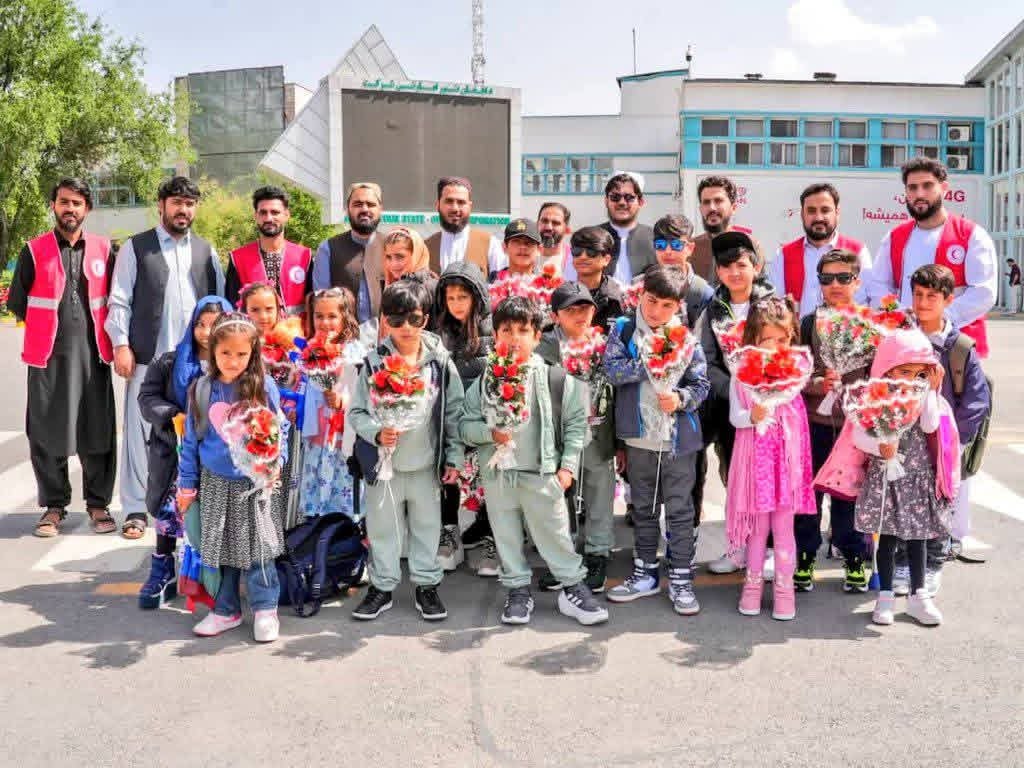
The Afghan Red Crescent Society, which operates under Taliban control, has announced that 19 Afghan children suffering from severe burns and bone infections have returned to Afghanistan after completing medical treatment in Germany.
According to the organization, the children were treated by the German charity “Peace Village,” and their transfer and treatment took place under a cooperation agreement between the Afghan Red Crescent and the organization.
Parents of some of the children told local media that treatment for their children had not been possible inside Afghanistan.
Shah Mohammad, the father of one of the children, said he spent around 200,000 Afghanis on treatment inside Afghanistan despite severe economic difficulties, but the efforts produced no results.
Germany’s Peace Village foundation has been transferring Afghan children with severe burns and bone infections to Germany for treatment for nearly two decades.
Doctors affiliated with the organization travel to Afghanistan each year to identify patients whose conditions cannot be properly treated inside the country and arrange their transfer for further medical care abroad.
The continued need to send critically ill children outside Afghanistan once again highlights the serious weaknesses of the country’s healthcare system.
These challenges include shortages of specialized medical equipment, limited treatment capacity for complex illnesses, and lack of advanced healthcare centers.
Health experts warn that Afghanistan’s economic crisis and declining international aid have placed additional pressure on the country’s healthcare system, making access to medical services increasingly difficult for many families.
Analysts say the case also demonstrates how foreign humanitarian organizations continue to fill major gaps in Afghanistan’s healthcare infrastructure.
Observers note that while the successful treatment of these children represents a humanitarian achievement, it also underscores the continued dependence of Afghanistan’s medical system on external support for specialized care.
Experts further warn that shortages of trained personnel, limited investment, and reduced international funding could deepen Afghanistan’s long-term healthcare crisis.