
Poland’s Border Guard has announced the arrest of four Afghan asylum seekers on charges of illegally entering the country.
According to the agency, a Polish citizen was also detained on suspicion of human smuggling.
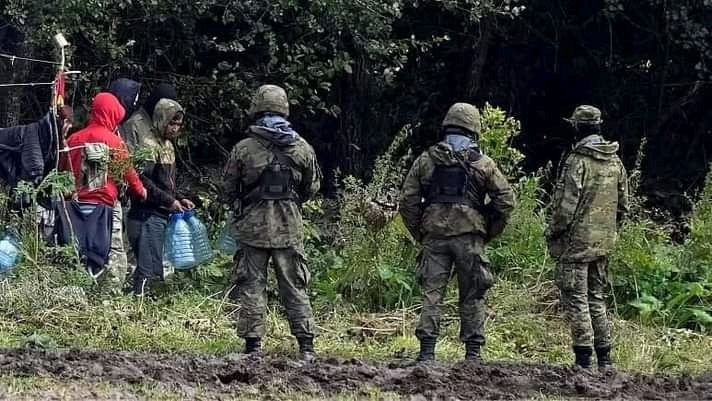
Polish border authorities said the Afghan migrants were attempting to reach other European countries, particularly Germany, through Poland.
Officials stated that the migrants first reached border areas and then crossed the frontier on foot.
After entering Polish territory, they were reportedly picked up by a Polish driver and transported toward other parts of Europe.
Polish border authorities had previously reported the detention of at least 84 migrants, including Afghan nationals, in border regions.
Afghan migrants frequently use the Poland route to reach Germany, a pathway that in recent years has become part of broader political tensions involving Europe, Russia, and Belarus.
According to the Associated Press, Poland accuses Russia and Belarus of using migrants as a tool to destabilize Western countries.
In response, the Polish government temporarily suspended the right to apply for asylum at the Belarus border.
Although the restriction was initially introduced for 60 days, Poland has repeatedly extended the measure, effectively halting asylum procedures for many migrants.
An Afghan asylum seeker told the Associated Press that Polish authorities decided to deport him without properly reviewing his case, solely because he entered through Belarus.
Human rights organizations and the UN refugee agency have criticized Poland’s policy.
They argue that suspending access to asylum violates international law and the Geneva Convention, which require host countries to assess each asylum application individually.
However, the Polish government insists that security threats along the Belarus border justify the recent hardline measures.
Analysts say the ongoing situation risks trapping Afghan migrants in one of Europe’s most dangerous and uncertain migration corridors, where humanitarian concerns increasingly intersect with geopolitical conflict and border securitization.