
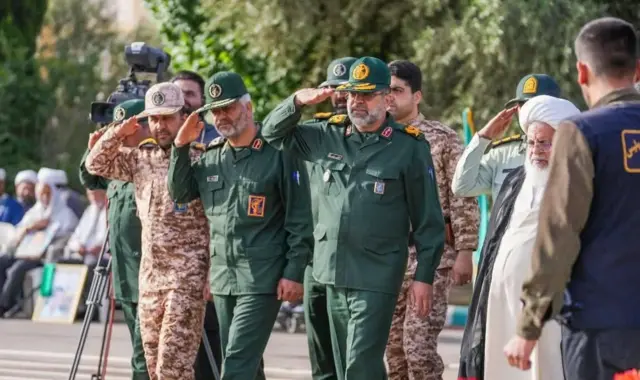
Military tensions between Iran and the United States escalated sharply on Saturday after Iran’s Islamic Revolutionary Guard Corps (IRGC) claimed it had launched missile strikes against what it described as “enemy bases” in response to recent U.S. attacks on targets in southern Iran.
In a statement released early Saturday, the IRGC said the operation was carried out following American strikes on locations in Sirik and Qeshm Island. Iranian authorities described the missile launches as a retaliatory measure but did not disclose specific targets, damage assessments, casualty figures, or precise locations allegedly hit during the operation.
The claims emerged as U.S. and Kuwaiti officials reported a series of missile and drone interceptions across the Gulf region, highlighting the growing risk of a broader military confrontation.
Kuwait’s state news agency reported that the country’s air defense systems intercepted multiple missiles and drones. The Kuwaiti Armed Forces later confirmed that sounds of explosions heard across parts of the country were linked to defensive operations and urged residents to follow security guidance.
The U.S. Central Command (CENTCOM) also announced that American forces intercepted several Iranian ballistic missiles and drones launched toward the Strait of Hormuz and neighboring Gulf states.
According to CENTCOM, Iran fired seven ballistic missiles toward Kuwait and Bahrain after four Iranian one-way attack drones were reportedly shot down by U.S. forces. The command said six missiles were intercepted, while the seventh failed to reach its intended destination.
CENTCOM further stated that American forces conducted strikes against Iranian radar installations in the Gurk area and on Qeshm Island, describing the action as a response to what it called an immediate threat to regional maritime traffic.
In the same statement, U.S. officials rejected Iranian claims that the U.S. Fifth Fleet in Bahrain had suffered damage, asserting that no American personnel, facilities, or military assets were harmed.
The latest developments come at a particularly sensitive moment for regional security. The Strait of Hormuz remains one of the world’s most strategically important maritime chokepoints, handling a significant share of global energy exports. Any disruption to shipping in the area has the potential to affect international energy markets and global trade flows.
While both Tehran and Washington have presented sharply different accounts of the confrontation, the competing narratives underscore the difficulty of independently verifying events during periods of rapidly escalating conflict. Neither side’s claims regarding operational success, damage inflicted, or military outcomes have been fully verified through independent sources.
The significance of the latest exchange extends beyond the immediate military actions. The confrontation now appears to involve not only direct strikes and counterstrikes but also regional air defenses, maritime security infrastructure, and the territory of neighboring Gulf states. That expansion raises concerns that future incidents could draw additional regional actors into the crisis.
With both sides signaling a willingness to respond militarily while rejecting each other’s accounts, the risk of miscalculation continues to grow. As tensions intensify around one of the world’s most critical energy corridors, regional governments and international observers are increasingly concerned that a localized confrontation could evolve into a broader conflict with far-reaching security and economic consequences.